

Well-Equipped Healers of Tomorrow
At Baylor University, pre-medicine is a program track rather than a specific major. The program requires specific courses students must complete to apply for medical school, but it does give students the flexibility to pursue any major.
The Office of Prehealth Studies has professional advisors to assist current Baylor University prehealth students with selecting coursework that is appropriate to their intended prehealth track. Advisors will also provide guidance regarding course load, academic progress, professional development, and information on majors, minors, and careers. AskPrehealth is online advising that takes place weekly via Zoom with no appointment necessary.
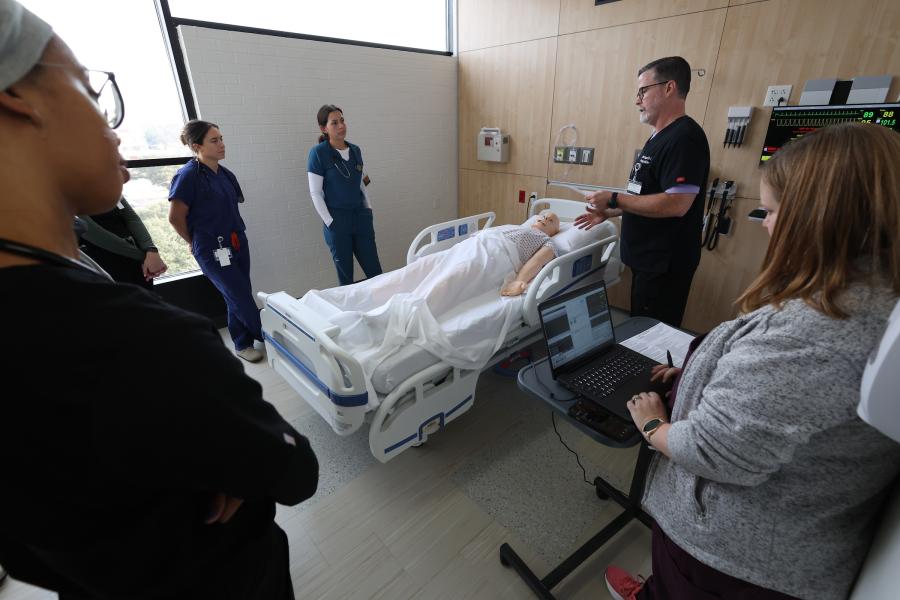
The newly created Clinical Simulation & Skills Facility (CSSF) on Cashion Academic Center’s fourth floor offers students a state-of-the-art environment to experience immersive, hands-on clinical instruction. Thoughtfully designed to replicate real-world medical settings, the facility features cutting-edge equipment and high-fidelity manikins representing patients of all ages with the ability to present a wide range of ailments and conditions.
The CSSF supports Robbins College’s Master of Physician Assistant Studies Program and other programs within the Physical Therapy, Occupational Therapy, Communication Sciences Disorders, and Human Sciences and Design departments.
Baylor’s Department of Medical Humanities program is one of a of the first of its kind in the country. The department is redefining how undergraduate students who aspire towards careers in and around healthcare can be educated and equipped, not only with an outstanding foundation in the sciences, but also with a rich experience in the humanities.
“About a third of our students are going on to medical school, another third go on to complete other medical certifications, and the remaining third are going on to healthcare administration and healthcare policy,” said Dr. Lauren Barron, department chair of medical humanities. “We are trying to bolster medical professionals at every level.”
Central to this degree are courses that focus on the role of Christian spirituality in healthcare, the importance of the relationship between patient and practitioner, and the changing nature of healthcare in the 21st century. The faculty have strong ties to the Waco medical community which allows them to offer outstanding opportunities for clinical experience, mentoring and service.
“Technology keeps improving and medical research keeps going as more things develop,” said Barron. “We need to reinforce the humanness of healthcare when it is easy to get distracted by more and more data. We want our students to consider ethical and spiritual issues they will encounter in with their patients to explore the deepest meanings of health and healing, and to embrace the sacred nature of their vocation in healthcare.”