

Secrets Beneath the Soil
Excavation reveals untouched ancient tomb
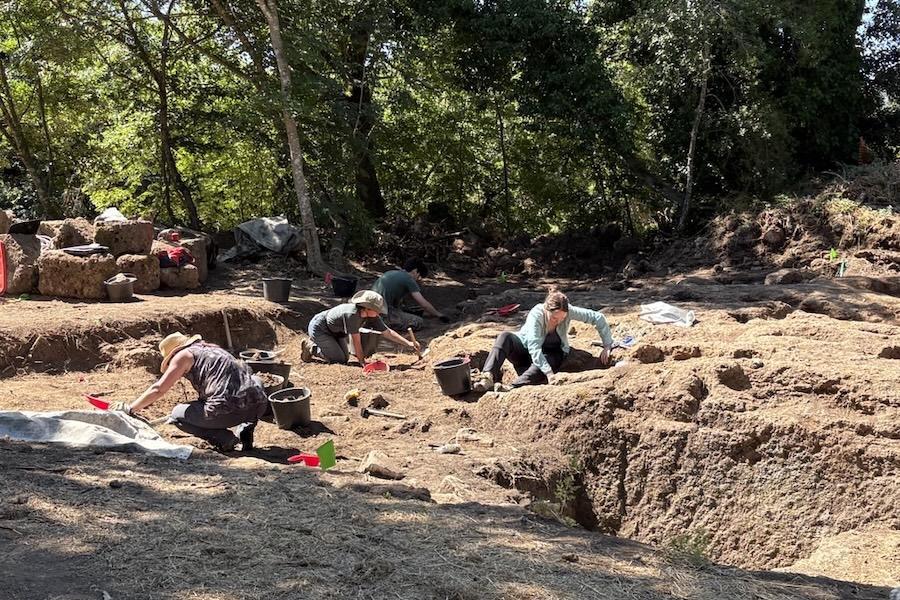
Just one year after uncovering a rare intact Etruscan chamber tomb in central Italy, a Baylor-led archaeological team has made another remarkable discovery.
Researchers with the San Guiliano Archaeological Research Project (SGARP) recently uncovered a second undisturbed Etruscan chamber tomb dated to the late seventh century B.C. at the San Guiliano necropolis near Barbarano Romano, Italy.
SGARP also serves as one of Baylor’s premier international research and study abroad experiences. Each summer, Baylor students participate in every stage of the archaeological process, from excavation and field documentation to laboratory analysis and conservation. In the SGARP laboratory, students work alongside international specialists to clean, catalog and study artifacts before they enter permanent collections or ongoing research projects.
While the discovery itself is extraordinary, archaeologists say its greatest value lies in what it can teach scholars about a pivotal moment in Etruscan history.
“Discovering a second intact tomb is incredibly exciting, but what makes it truly significant is what it allows us to learn,” said Davide Zori, Ph.D., project director and principal investigator of SGARP and professor of history and archaeology in Baylor’s Honors College.
The newly discovered tomb was sealed for more than two millennia. Inside, archaeologists found 13 pottery vessels and an iron pin with traces of preserved textile fragments, a rare find that may provide insight into Etruscan clothing and weaving practices. The chamber also contained the remains of at least two individuals, possibly three, whose skeletons are unusually well preserved. The preservation opens the door for future DNA and isotopic analyses that could reveal family relationships, diet and place of origin.
The discovery follows SGARP’s 2025 excavation of the intact “Tomb of the Painted Bird Vases,” which contained more than 100 objects and attracted international attention. Having two untouched tombs from the same era now allows researchers to compare burial practices within the same community.
“Having the two tomb assemblages to examine allows our team to better identify potential vases that were used in daily life and those that might have been placed in the tomb as part of the funerary ritual,” said Jerolyn Morrison, B.F.A. ’95, Ph.D., SGARP laboratory director and Baylor assistant professor of art history. “That is vital for developing a deeper insight into how people lived and the tools that they used.”
The discovery demonstrates how years of interdisciplinary collaboration, scientific excavation and international partnership continue to transform understanding of the ancient Etruscan world while providing Baylor students with hands-on research experiences that extend far beyond the classroom.