

Rooted in Baylor, Reaching the World
2026 Baylor Alumni Awards
Each year, the Baylor Alumni Awards recognize graduates who embody and reflect the power of the Baylor experience. These individuals have shown dedication to their respective callings in remarkable ways. The awards stand as a testament to how the University develops men and women for worldwide leadership and service by integrating academic excellence and Christian commitment within a caring community.
The honorees of the 2026 Baylor Alumni Awards exemplify what it means to carry forward Baylor’s mission, building a legacy that impacts communities around the world and continues to reach across generations.
Alumnus of the Year
John David Rainey,
B.B.A. ’93, M.B.A. ’95
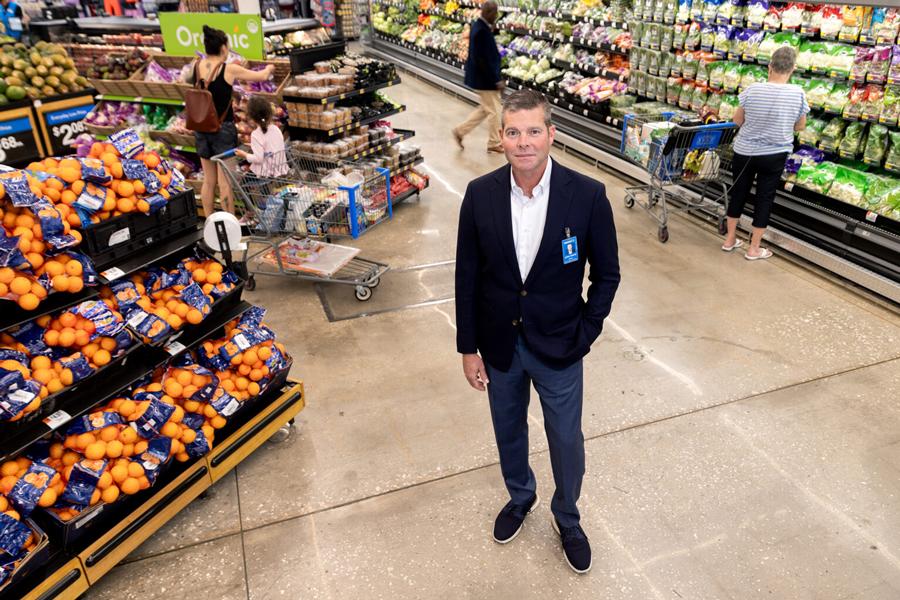
As the executive vice president and chief financial officer of Walmart, John David Rainey, B.B.A. ’93, M.B.A. ’95, has reached the highest levels of corporate leadership while staying grounded in the values that have guided his career from the beginning.
“I credit Dr. Terry Maness with sparking the flame for me on having an interest in finance,” said Rainey. “And if Dr. Maness
sparked the flame, then Dr. Bill Petty fanned the flame. Taking his class was the moment where I realized this is what I want to do as a career, that I want to be in finance. I really loved the intellectual challenge of solving problems through finance and through numbers.”
With his passion for finance established as an undergraduate at Baylor, Rainey felt graduate school on his horizon as the next logical step. A self-reported average student, he applied without much stress and was met with rejection.
“That felt like a punch in the gut. I felt like all was lost.”
Rainey put on his nicest clothes, went down to the admissions office, and met with the dean. He asked him to reconsider his decision, stating that he was the kind of student they want in their program. The dean allowed him to write a formal letter asking for reconsideration to enter the graduate program. Rainey mailed his letter later that afternoon, and, after weeks, he had advocated a spot for himself.
“I think that single moment probably has done more to influence what I’ve done since then than maybe any other moment. That was the moment in my life where I realized I may not achieve things that I want in my life, but it’s not going to be because I didn’t work hard enough.”
For Rainey, hard work has been the constant, and he has learned that everybody plays an important role. People come from different backgrounds, but it doesn’t define their worth as individuals. Every role is as needed and unique as the people in those roles.
“I grew up in Angleton, Texas, a community where people of every walk of life shopped at the same grocery store. If you play little league baseball, you’re playing there with the lawyer’s kids and also the janitor’s kids.”
Rainey worked construction for five years during the summers and winters of college. There were a lot of summers when he was the only English speaker on the construction crew. Some of those people were really good friends, and he learned to embrace these different walks of life.
“When you’re thrust into a professional community, I don’t think you lose that sense of camaraderie,” Rainey said. “If the CFO knows the janitor’s name, what does that say about everybody else needing to know that?”
Rainey’s personal culture of inclusiveness has permeated each work environment he has belonged to. He was working at Continental Airlines during 9/11, and they were one of only two airlines to not file bankruptcy. Later, when Continental merged with United Airlines, there was a tension between management and the unionized pilots and flight attendants, so he made it his goal to win this group over for them to all get on the same page. When he left United to work at PayPal, the pilot’s union honored Rainey with an honorary captain award.
“Careers today are less about spending your working years at one company moving up the ladder. A career now is about honing skills and applying those to your calling. Callings can shift in a lifetime, which can be an intimidating and daunting idea. However, it also can be energizing and invigorating to learn and to try to master something new.”
Life at PayPal was different because it was a digital business experiencing a wave of FinTech in which companies like Venmo, CashApp and Apple Pay were starting to take off. Rainey had to adapt quickly to an ever-changing industry that was very different than where he had been for 18 years.
“You have to be comfortable not being the smartest person in the room, especially when you move to a new industry. Be confident in your abilities that have gotten you to that point, but never stop being a sponge to soak up new information and knowledge. You may miss opportunities meant for you if you’re too scared to take that step.”
Now at Walmart, the environment is a combination of Rainey’s previous two jobs: capital intensive and brick-and-mortar like the airlines but also a fast-growing digital presence that is now 25% of all Walmart’s business today. A perfect blend of all the stops along his road so far.
“You have to determine what success looks and feels like to you and not let others be the yardstick by which you measure success,” he said. “There is no secret code to success but that doesn’t mean it’s complicated. Work hard and treat people well then everything else is going to fall into place.”
Pro Ecclesia Medal of Service
Kenyatta Gilbert, B.A. ’96
“I am who I am because of the cradle that shaped me,” said Kenyatta Gilbert, B.A. ’96, Ph.D. “I am the product of both a working pastor father and elementary educator and entrepreneur mother.”
These early influences are apparent in Gilbert’s current roles as dean of the School of Divinity and professor of homiletics at Howard University, where he cultivates curious minds, thoughtful voices and a deeper understanding of faith.
Gilbert’s parents, Robert and Elwayne, allowed him and his siblings to explore the world on their own terms and ask questions about God. He credits them for always feeling deeply empowered as a curious person and now as a critical mind. Following in his father’s historic footsteps to Baylor, Gilbert earned a bachelor’s degree in political science with an idea of perhaps working on Capitol Hill one day.
During his time at Baylor, Gilbert was chaplain for Alpha Phi Alpha, president of Heavenly Voices and even started a bible study, Nexus.
“I did those things out of a sense of exploration, curiosity and a strong sense of call, which became the catalyst for continuing to say yes to things I didn’t feel ready to do.”
Although law school felt like a probability, there was a lingering pull toward theology and seminary. Gilbert attended Princeton Theological Seminary and later found a unique home at Howard University close enough to that Capitol Hill dream.
“I think about humanity first; persons are formed, and everyone is in different places in their formation.”
At Howard, Gilbert has found a sense of cultural community that sustains him and keeps him grounded in his own racial, cultural, spiritual and intellectual identity. Furthermore, as a historically Black university, and the only one to attain R1 status, Howard has enabled him to connect to a wider population of people who are asking questions in a culturally contextual and diasporic way.
“I have great affection for where people are in their journey and how they access faith or not, how they think about life and what shapes their worldview,” said Gilbert. “I think my experiences are unique to my outlook and my perspective theologically, socio-politically, what I believe devotionally and biblically.”
Howard University doesn’t have an undergraduate religion program, nor does it have a freestanding seminary. The identity of the School of Divinity is tied to an appreciation of the Christian faith but also a wider appreciation that difference in diversity, culture, religion and geography makes for a greater and deeper conversation.
“I have established my voice here,” Gilbert said. “Because I have, it empowers me to help others establish their own. There’s no riskier or better vocation than preaching for that voice to materialize.”
Homiletics, the study of preaching, allows one to see the interconnections between theology and other defined disciplines and how that informs the formation of a person. Gilbert prefers the title of class facilitator rather than professor when it comes to teaching. He brings the tools he has along with his years of experience to the table to engage in conversations where others bring their own tools and experiences.
“I want students to do the work, to be better than who they were prior to coming into the class,” Gilbert said. “I marvel at how God speaks through other people.”
The challenge, Gilbert said, is that the younger people trying to get into this work have shifted focus toward too much connection and not enough reflection. Part of that mindset is society urging productivity over meaning, quantity of connections over depth of relationship. Gilbert noted that it’s a great time to do theological work because it’s multifaceted. It’s labor-intensive and requires creative problem solving and reflection, but it is incredibly gratifying.
“Faithfulness can be the mark of your life,” Gilbert said. “That’s what I want to be said about me when I make my transition. That I was faithful, I was sincere, I understood my limitations, but I also understood that every day brings an opportunity to do better, to do more, to love better, to love more, to serve better, to serve more and to rest and reflect.”
Pro Texana Medal of Service
Brenda Snitzer, B.S.Ed. ’85, M.S.Ed. ’86
“I enjoyed life at Baylor in my undergraduate years,” said Brenda Snitzer, B.S.Ed. ’85, M.S.Ed. ’86. “I really think fondly of my roommates and all the people that I got to know at Baylor. I joined Delta Gamma sorority as a freshman. I loved intramurals, loved all the social activities, loved that it was a Christian environment and that it supported my values.”
Going from her undergraduate degree straight into a master’s program at Baylor, Snitzer was able to soak in as much Baylor life as she could. She then became a probation officer in the inner city of Dallas as a way to get to know the community. During those first years, Snitzer laid the foundation for what would become a career of loving thy neighbor as executive director of The Stewpot, a ministry that serves those in poverty in Dallas. For people who are born into poverty with few resources, it’s often difficult for them to get out of poverty without either intervention, resources or others assisting them. After witnessing the aftereffects first-hand, Snitzer started moving into the nonprofit community and to organizations that focus on prevention or intervention and supplying resources to people who are in poverty or have other areas of need.
“I never intended to be criminal justice-led. I am more of a social service-led person to help folks.”
Sometimes people who are in need end up getting put into the criminal justice system because they are misunderstood or not heard. Snitzer believes and embodies reaching out to people and deescalating situations to help them. The way to break the poverty cycle is to be proactive instead of reactive when able, she said, and to try to eliminate the many constraints that bind helpful resources.
When Snitzer became Presbyterian with her family, she was the youth director and Christian educator at their church. She would bring the adults and youth to come and serve at The Stewpot, do meal service and help in the Saturday school program. When the position opened for the executive director of The Stewpot, it felt like the right place to bring together all the things she had done in her career so far.
One of the first improvements Snitzer made was The Stewpot’s environment and facility that had been neglected. The physical campus was transformed to make it a beautiful place for people to come, to heal, to be heard and to move forward with their lives. The space also became more inviting and nurturing for the community to gather — a fertile ground for new starts to blossom.
“I think the loss of community is the hardest thing for folks that are experiencing homelessness.”
With the inviting nature of the space established, creative programming for the neighbors at The Stewpot began to take shape. The art program provides studio space and supplies free of charge to neighbors. There are various opportunities for the artists to show and sell their original work, with 90% of the sale price going directly back to the artist. Snitzer said artists in the program recently were able to partake in a special FIFA World Cup art showcase, in which artists were given a circular canvas to decorate and show.
The writers’ workshop is for any skill level. Many participants of this group write about their own experiences, develop poetry skills and learn how to advocate for themselves in the written word. Other creative programming includes the Dallas Street Choir and the street paper, STREETZine.
“It’s about spiritual enrichment, the whole person,” Snitzer said. “When folks feel nurtured in the whole person, it really makes a difference in the change for their lives.”
Snitzer likens The Stewpot to what she experienced as a student at Baylor — the community and the love and care that reflect the way of Jesus. Not everybody at The Stewpot is a Christian, but she said everybody there tries to love and serve and care for each other as neighbors.
“Love is active — service is transformational.”
Snitzer has witnessed when people come to volunteer, they are transformed and become part of the neighbors and the community. Often neighbors who have been served return to volunteer. The ministry that Snitzer stewards is a beautiful community committed to replacing a cycle of loneliness and shame with a cycle of giving and love.
Pro Mundo Medal of Service
Biak Nu Sung, M.S.W. ’12
Growing up in Chin State of northern Myanmar, Biak Nu Sung, M.S.W. ’12, is familiar with villages that were almost exclusively Christian and spoke in their own dialect. After primary school, her family moved to the middle of the country to follow her father’s missionary work. Being suddenly surrounded by devout Buddhists speaking Burmese was a culture shock without leaving their home country. Biak’s global journey was just getting started.
While completing her undergraduate theology degree in Singapore, she met Pastor Tom Ogburn, D.M. ’05. Ogburn highly recommended the Global Missions Leadership Scholars Program, a master’s program within the Diana R. Garland School of Social Work. Without knowing anything about Texas, Waco or Baylor, Biak came to attend and flourished.
“Every course, every professor, I felt seen,” said Biak. “I didn’t have a textbook grasp of what social work was, but each class felt like an ‘aha!’ These were the topics I really wanted to study.”
Biak is devoted to children in her community. She earned a master’s with a concentration in children and family practice and connected theory to practice by checking on her niece’s developmental milestones. It also allowed her to reflect on the development of her own family, growing up in a dictatorship and with her and her sisters treated as equal to their only brother — a cultural anomaly.
After graduating from Baylor, Biak returned to Myanmar for mission work, utilizing the frameworks she had acquired. Still, something was missing. She asked God for a sign, for passion and zeal and for job satisfaction. When it never came, she started looking elsewhere and found a role as a child protection specialist with UNICEF.
“All I knew about UNICEF was that they provided aid. I didn’t even realize that it was part of the United Nations,” Biak said. “But during the final interview, I felt a deep sense of peace — like divine intervention.”
Child protection and child development are two sides of the same coin. In order for children to develop appropriately, they need to be safe and protected from harm, abuse or maltreatment. This includes informing and teaching parents to understand how raising their children will affect them.
“We can do a lot of prevention at the family level,” Biak said. “We don’t always need to respond with case management.”
Many of the families Biak educates in the rural villages don’t have much, but they have farms, plants and community. She encourages them to use what they have to learn about science, math, structure and faith.
“If we sow the seed of the gospel when they are children, God may continue to work and show them as they grow,” said Biak, echoing her father’s life mission. “All people, regardless of if they are in poverty or not, are shaped and formed by their environment and what the people around them believe. For places that are predominantly one religion, there is an expectation to conform without conversations or questions about what else may be out there.”
With the addition of Pro Mundo to Baylor’s mission, many may assume graduates are simply taking what they learn from Baylor and then dispersing to the corners of the map. For Biak Nu Sung, it means embodying the role of a true scholar of the world, with Baylor as one of her many stops. Her Christian faith calls her to return home to a place many of us may never experience ourselves and encourage the growth of the next generation.
“I feel responsible for the people in Myanmar,” Biak said. “I’ve been fortunate to visit and work in beautiful places, and I hope I can share just a little bit of that with them. How can I bless them with what I have been blessed with?”
“Jesus was the first social worker because he cared not only about the soul but also physical and emotional needs,” Biak said. “Following in my dad’s footsteps, I think I would’ve made him very proud.”