

Pro Texana: Research Aligned with Texas’ Leadership in Exotic Materials
Baylor University and our home state of Texas share a rich history. Chartered by the Republic of Texas in 1845, Baylor is the oldest continually operating university in the state. Today, Baylor is helping Texas meet current and future needs through research in areas closely tied to the state’s future. Positioned in the heart of the dramatically growing Texas Triangle region, Baylor addresses challenges that drive competitiveness in fields expected to see significant growth in the coming decades.
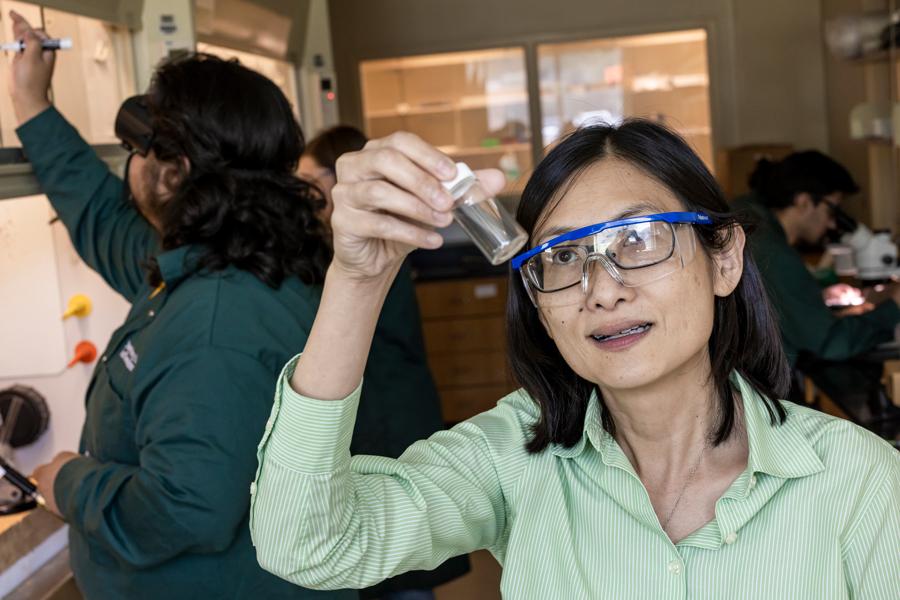
One such area comes in the futuristic-sounding field of quantum materials. Texas has taken steps to strengthen its position in quantum technology, an innovative discipline expected to influence future computing, sensing and communications technologies. Julia Chan, B.A. ’93, Ph.D., the Tim and Sharalynn Fenn Family Endowed Chair in Materials Science, studies quantum materials, which are compounds with unusual electronic and magnetic properties that can enable entirely new technological capabilities. Her research focuses on discovering and understanding materials that could one day support advances in areas such as quantum computing, high-density data storage and next-generation sensors.
A Baylor alumna who returned to campus after more than two decades at leading research universities like UT-Dallas and LSU, Chan is advancing our materials science profile while pursuing research at the forefront of the field. Much of her work centers on identifying and designing materials whose properties could unlock technologies that do not yet exist.
“Quantum materials with exotic electronic properties can enable completely new applications that we have yet to discover,” Chan explained, “generating novel routes to magnetic field sensors, power modules, memory modules, high-density storage devices and quantum computers.”
From advanced aerospace materials to semiconductor efficiency and quantum science, Baylor researchers are engaged in fields that align with Texas’ evolving needs. As the state continues to grow, that work contributes to the scientific foundation behind the industries shaping its future.