

Preparing Students to Tackle the Unknown
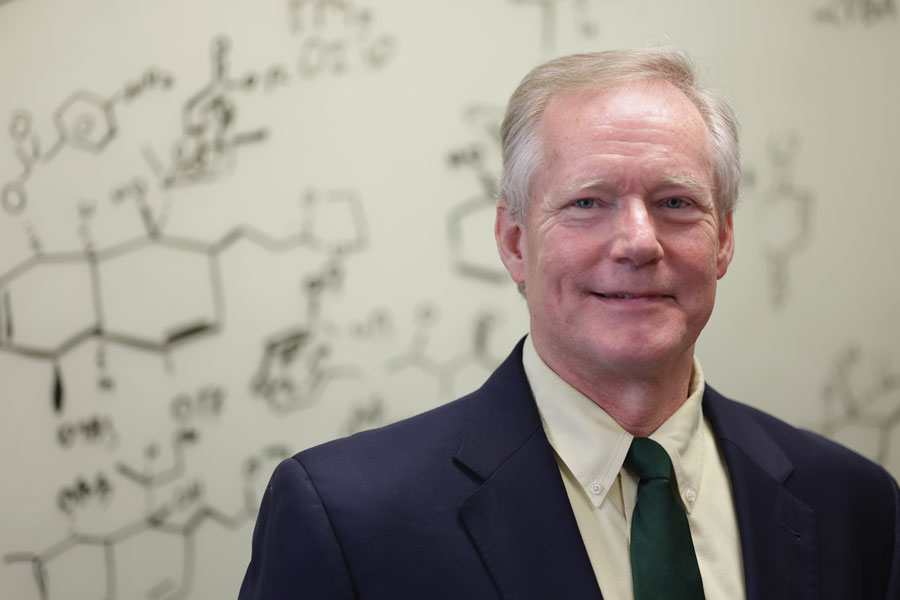
John Wood is a nationally recognized leader in the chemical synthesis of natural products that could someday become drug leads to treat cancer and other diseases. He came to Baylor in 2013 after serving on the faculties of Yale and Colorado State. He has been recognized with the coveted Ernest Guenther Award for outstanding achievement and was awarded Baylor’s highest honor as University Distinguished Professor. He says his greatest achievement, however, is the development of students—which is why, as he explains here, he spends so much time investing in them.
When people hear about the research that takes place in my laboratory, they often focus on the broad idea of drug leads or fighting cancer, or the work we do with molecules. That's understandable. We spend our time trying to build complex natural products, solving difficult synthetic problems and, occasionally, creating compounds that may someday contribute to new medicines. But the truth is that the molecules are not the most important thing we produce: the students are.
Every student who joins my laboratory steps into an environment where there are very few guaranteed successes. We operate at the very front edge of the drug discovery process. They spend their days confronting problems that have never been solved before. They design experiments without knowing whether they'll work. Most of the time, they don't.
My role is to ensure that the environment in our laboratory is one wherein students can grow through their experiences and feel comfortable interacting with both their fellow students and me. It is important for them to become comfortable with uncertainty and understand that failure is not the opposite of success; it's often the path to it. The students who thrive are the ones who learn to encounter problems head-on by developing an understand of underlying issues, overcoming them, and then moving enthusiastically on to the next challenge.
We’re working to produce problem solvers. We want students to be able to face something difficult, persist through setbacks and find a way forward. Research is an ideal training ground for developing that kind of resilience. The most rewarding moments of my career happen when a student reaches the point where the project becomes their own. They come up with an idea independently, test it and discover that it works. In that moment, they stop simply following instructions and start thinking like a scientist. Watching that transformation never gets old.
At the end of the day, the lasting impact of my work is about more than molecules: it’s about students who leave the laboratory prepared to solve problems, embrace challenges and confidently tackle the unknown for the rest of their careers.