

Honoring the Legacy of a Leader in Christian Higher Education
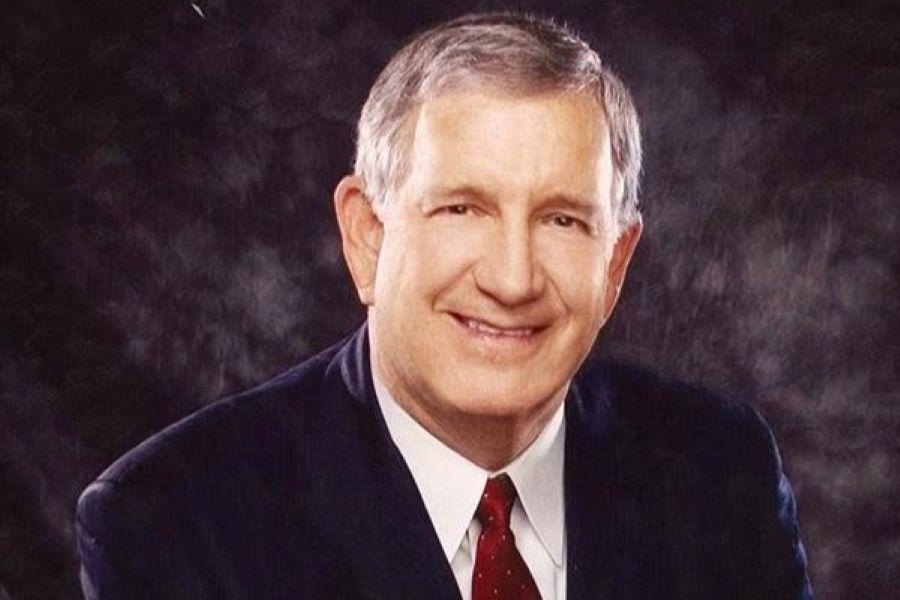
Only 15 individuals have served as president of Baylor University since its founding in 1845. On July 4, the Baylor Family lost a member of that exceptional group of Christian leaders with the death of Dr. Robert B. Sloan Jr. in Houston.
As Baylor’s president from 1995 to 2005 and Houston Christian University’s president during the past 20 years, Sloan left a lasting legacy at the two institutions and more broadly across the landscape of Christian higher education in America.
“A proud Baylor alumnus, Robert Sloan faithfully served Baylor University as a member of our religion faculty, founding dean of George W. Truett Theological Seminary and as Baylor president for nearly a decade,” Baylor President Linda A. Livingstone, Ph.D., said upon the news of his death. “His greatest contribution was the adoption of Baylor 2012, a 10-year vision that placed Baylor on the path to become a top-tier university while remaining committed to our historic Christian mission. And that is where Baylor stands today.”
A Baylor family
Sloan served as the 12th president of Baylor, leaving his position as Truett Seminary’s dean to take the position. The Texas native first set foot on Baylor’s campus as a student in the late 1960s. There he met and married his wife, the former Sue Collier, B.A. ’70, before graduating with a Bachelor of Arts in 1970.
He then attended Princeton Theological Seminary, where he earned a Master of Divinity in 1973. After conducting post-baccalaureate research in church history at the University of Bristol, England, in the early 1970s, he earned a Doktor der Theologie from the University of Basel, Switzerland, in 1978.
Sloan returned to Baylor in 1983 as a faculty member in the Department of Religion. In 1990, he became the first holder of the George W. Truett Chair in Evangelism at Baylor, and he was appointed dean of Truett Seminary in 1993. Baylor regents, in February 1995, named Sloan to succeed Dr. Herbert H. Reynolds as president of the University.
Over the course of Sloan’s career as a minister, educator and Christian higher education leader, he and Sue had seven children, all of whom went on to become Baylor graduates. At the time of his death, the Sloans had 26 grandchildren.
Vision for growth
At the conclusion of his tenure as Baylor’s president, Sloan was asked to reflect on the most significant initiatives he had overseen as president. He spoke at length about Baylor 2012, the 10-year vision adopted in 2002 that articulated the University’s aspiration of becoming a top-tier research university with a strong Christian identity, among other goals.
“I maintain, as we speak, that a university that does not have a serious research dimension to its academic life cannot and should not be taken seriously as a university. There is a wide variation in how that is actually implemented by different faculty members and different departments and schools, but the position that research and discovery are essential to what it means to be an academic institution seems to me indisputable,” he said, before specifically commenting on Baylor 2012. “I know it represented a culture shift for Baylor, but in many ways that position is very consistent with the trajectory of the University and the learning and public statements represented by such Baylor presidents as William Carey Crane and Samuel Palmer Brooks and other leaders of Baylor over the years.”
As dean of Baylor’s Graduate School from 1998 to 2025, Dr. Larry Lyon, B.A. ’71, saw the full trajectory of Sloan’s vision for Baylor — from its inception to its fulfillment when the University was recognized as a Research 1 university by the Carnegie Classification of Institutions of Higher Education in 2021.
“In 1995, when he was being considered as the successor to President Reynolds, Robert Sloan shared with me his audacious vision for Baylor as a great Christian research university. While I appreciated the value of his vision, I could not overlook the more than 200 years of secularization in higher education that made such a path seem highly unlikely,” said Lyon, who was an early proponent of raising Baylor’s scholarly profile and led an instrumental self-study of the University in the mid-1990s.
“Fortunately, I did not dissuade Robert and even more fortunately, while the path was difficult, Baylor ultimately demonstrated the validity of his vision,” Lyon added. “Today, thanks to Robert Sloan and those who supported and advanced Baylor 2012, Baylor stands as an intentionally Christian university fully embracing its research mission — a remarkable achievement that many once thought impossible.”
From Waco to Houston
In November 2006, Sloan began serving as the third president of Houston Baptist University, which changed its name to Houston Christian University (HCU) in 2022.
According to the university, the institution’s enrollment and campus experienced unprecedented growth during his two decades in office. One of his signature initiatives was “The Ten Pillars: Faith and Reason in a Great City,” a 12-year vision to fulfill HCU’s responsibility for the renewal of Christian higher education. Sloan also had led HCU through the creation of its first doctoral program in executive education leadership and the founding of the Houston Theological Seminary.
“Dr. Sloan led HCU through her most monumental and glorious years, impacting countless lives of students, faculty, alumni, staff, trustees and friends,” said HCU Board Chairman Ramiro Peña (BA ’88), pastor of Christ the King Baptist Church of Waco and former Baylor University Regent (2005-2014). “The fingerprints of Dr. Sloan’s leadership will continue to be upon the success of HCU for generations to come, and the impact of his presidency will yield outcomes both measurable and eternal.”
Dr. Barry Hankins, B.A. ’78, M.A. ’83, a longtime professor of history at Baylor, is currently writing a book about Baylor’s rise as a top-tier Christian research university. Sloan figures as a prominent presence in the work.
“When Robert Sloan became president of Baylor, his main concern was maintaining and strengthening Baylor’s Christian identity. Over the first two years of his presidency, however, while working with his provost Don Schmeltekopf, he caught a vision of Baylor as a Christian research university — a Protestant Notre Dame,” Hankins said. “The result was Baylor 2012, the 10-year vision that launched the University toward the R1 status achieved under President Linda A. Livingstone. Sloan was a visionary and a determined leader. After Baylor, he went on to do good things at Houston Christian University, but his historical legacy will always be what he started at Baylor.”