

Honoring the Immortal Ten
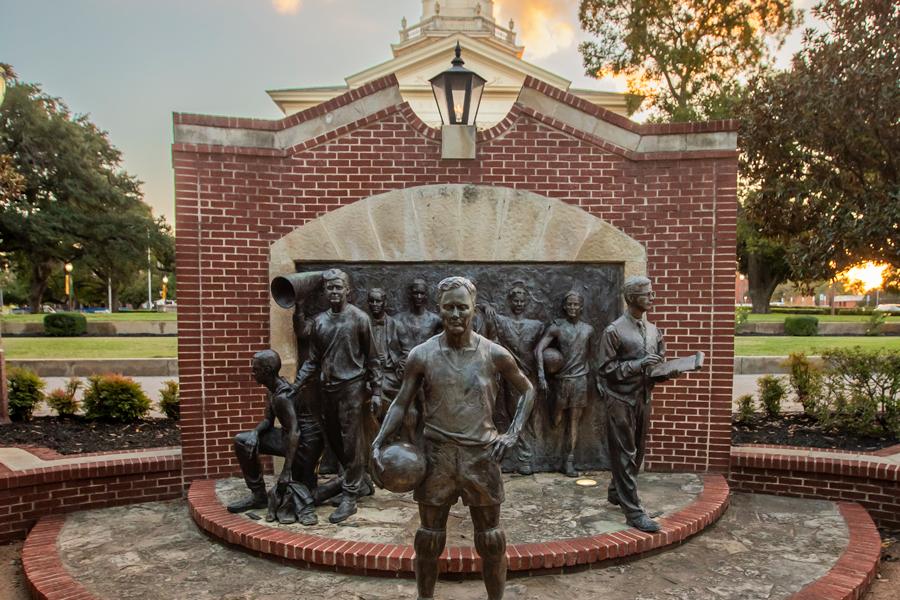
On January 22, 2027, the Baylor Family will mark the 100th anniversary of the bus-train accident in Round Rock, Texas, that took the lives of 10 Baylor students who subsequently became known as the Immortal Ten.
Their story is told each year at the Mass Meeting, held during Homecoming week for current Baylor students. Additionally, their legacy is honored with the Immortal Ten Memorial, a group of bronze statues in the center of campus that serves as a physical reminder of the Immortal Ten tradition and symbolizes the abiding value of faith, community and hope.
The events surrounding the origin of the Immortal Ten tradition can be easily summarized.
On the morning of January 22, 1927, Baylor’s men’s basketball team left campus in the University’s athletics bus to play the University of Texas that night in Austin. The game, however, would never be played. Ten of the 22 passengers died when a train hit the team’s bus at a railroad crossing in Round Rock — the worst such accident in Texas history at the time. The students who died soon became known as “The Immortal Ten,” eulogized across the state and the nation.
A broader, deeper part of the Immortal Ten tradition is the meaning it continues to hold today, 100 years later.
A Lasting Tradition
In the accident’s immediate aftermath, the primary focus of the Baylor community was on supporting family, friends and classmates and ensuring that the memory of the 10 students would be preserved. Baylor was much smaller back then, with an enrollment of about 1,300 students, and the impact was deeply felt across campus.
It wasn’t, however, simply a Baylor story. Given that the students who died came from nearby and across the state, it also was a tragedy that brought Waco and the entire state of Texas together.
“The story of the Immortal Ten embodies the Baylor spirit, both as it was in 1927 and as it is today,” said Todd Copeland, B.A. ’90, director of advancement marketing at Baylor and the author of The Immortal Ten, published by Baylor University Press, which, he said, “offers readers a narrative that presents the details of the tragedy, but it also explores the power of friendship and community and the strength and perseverance of the human spirit.”
Today, the annual Mass Meeting is a beloved part of Baylor’s Homecoming festivities, reminding students of their unique responsibility to care for and value one another as individuals and collectively as part of the Baylor Family.
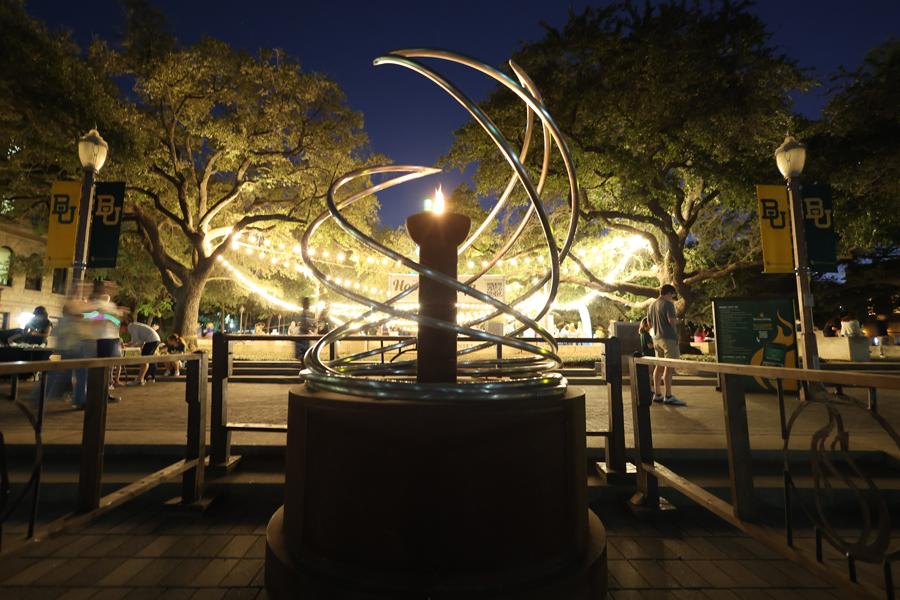
After the story of the Immortal Ten is shared at the event, 10 current students — each representing one of the young men who died in 1927 — take their places in front of chairs over the backs of which are draped jerseys that read “Baylor 10.” At the gathering’s conclusion, the students use lit candles to light the Eternal Flame torch, which the freshman class representative receives from the other classes’ representatives. All are designated as Baylor Homecoming Torchbearers, and together they light the Homecoming bonfire the following night. Last year, a representative from Baylor’s graduate student community was added as one of the class representatives.
“Torchbearers are the keepers of the Baylor spirit,” said Brian Segers, a Baylor senior from Grand Junction, Colorado, who coordinated the Mass Meeting in 2025. “They represent what it means to live ‘Pro Ecclesia, Pro Texana, Pro Mundo’ — to take the light of Baylor into the world.”
As Segers looks toward the centennial of honoring the Immortal Ten this fall, as well as on the accident’s anniversary in January, he said he believes the tradition has two meanings for current Baylor students.
The first is straightforward — honoring the memory of the 10 Baylor students who lost their lives. The second meaning is broader.
“Baylor is often described as a large campus with a small-campus feel, and I believe that events like the Mass Meeting contribute to this feeling,” Segers said. “It has been almost 100 years since the Immortal Ten passed, and yet we still honor them as individuals. For me, this means what I do as a student — even with how large Baylor has become — matters to the University and our campus community. I believe this feeling is something uniquely present at Baylor and is exemplified by our continued remembrance of the Immortal Ten.”