

Developing Leaders
Students in Baylor’s Hankamer School of Business benefit from programs designed to enhance leadership skills.
Each generation of Baylor University students has gone out into the world ready to make a difference as leaders in their communities and professions.
As times change, the environment of leadership naturally evolves to meet new opportunities and challenges. Nevertheless, developing leadership skills has remained steadily focused on helping students answer a set of foundational questions. These include “How can I have the faith and integrity to do what is right in the face of competing pressures?” and “How can I apply my passion and knowledge to ends that transcend mere self-interest?”
Baylor’s success in preparing students for worldwide leadership and service has been recognized by several organizations over the years. Most recently, in February, Baylor was named to TIME Magazine’s list of the Best Colleges for Future Leaders for the third consecutive year — a ranking that measures universities that excel in nurturing the career trajectories of the nation’s most highly influential leaders. Baylor was ranked No. 70 nationally and No. 4 in Texas.
Global Perspective
To achieve success in such rankings requires demonstrating success on a daily basis in helping students achieve their goals and providing them with a dynamic education grounded in Baylor’s Christian mission.
Today, students enrolled in Baylor’s Hankamer School of Business enjoy the opportunity to participate in several programs that are specifically designed to assist them in shaping habits and virtues that are fundamental to effective leadership. A Baylor education inspires them to lead with purpose, live for human flourishing and pursue a vision that transforms the world.

“Our mission is to develop leaders through competence and character,” said David M. Szymanski, Ph.D., The William E. Crenshaw Endowed Dean of the Hankamer School of Business. “Our commitment to developing principled leaders is rooted in our Christian mission and expressed through the transformational experiences we provide for our students each day.”
Prominent among the experiences that serve to broaden students’ understanding of the surrounding world, at both the undergraduate and graduate levels, are study-abroad programs. Each year, groups of Baylor business students take Baylor faculty-led classes in locations around the world. These opportunities introduce them to cultural perspectives found in unfamiliar settings while allowing students to work toward their degrees. Through partner universities and organizations, students also can spend a full semester abroad, in places like Dublin, Florence and Sydney, for a deep immersion in the customs, languages and practices found in other countries.
One recent venture took M.B.A. students to Santiago, Chile, and Buenos Aires, Argentina, where they explored sectors of trade, tech, energy, manufacturing and food.

“By offering students this distinctive opportunity, we empower them to cultivate cultural agility and leadership capabilities — skills that are increasingly essential in today’s global marketplace,” said Dawn Carlson, B.B.A. ’89, M.B.A. ’91, Ph.D., H.R. Gibson Chair of Organizational Development and director of the McBride Center for International Business.
In addition to coordinating such study-abroad programs, which broaden students’ understanding of how business is done in other countries, the McBride Center cultivates transformational worldwide discovery and scholarship for students, faculty and staff by supporting scholarship on worldwide business topics across all business school disciplines. Carlson noted that these initiatives will eventually impact the global marketplace by preparing students for success in their chosen fields of business.
Specialized Focus
The Hankamer School of Business has a long history of developing future leaders. Its first students enrolled in 1923, and the first graduates earned their Bachelor of Business Administration degrees in 1925. Today, the School continues to cultivate principled leaders to serve in domestic and international marketplaces through transformational learning and impactful scholarship — all within a culture of innovation guided by Christian values.
Wide-reaching initiatives like the McBride Center are complemented by others more narrowly focused on particular niches in the business world. The Center for Professional Selling (ProSales) is one such program. Established 40 years ago, the Center has a long track record of success in developing students’ leadership skills and placing them in upward-tracking jobs.

By incorporating 12 competencies into the program’s curriculum, ProSales provides a strong foundation upon which students build their careers during the first decade or so after graduating, noted Andrea Dixon, Ph.D., the Frank M. and Floy Smith Holloway Professor, who has served as the Center’s executive director since 2009. What ProSales describes as its “college-to-career” development initiatives include the student-led Professional Development Program (PDP), which offers events that expose students to various career paths, workshops and experiences, as well as the Top Gun Training Program in which executives engage with students to provide input to prepare them for the career-search process and for the workplace.
Beyond equipping students for a strong start to their careers, Dixon has found that the skills emphasized in the ProSales curriculum overlap with those required to become C-suite executives.
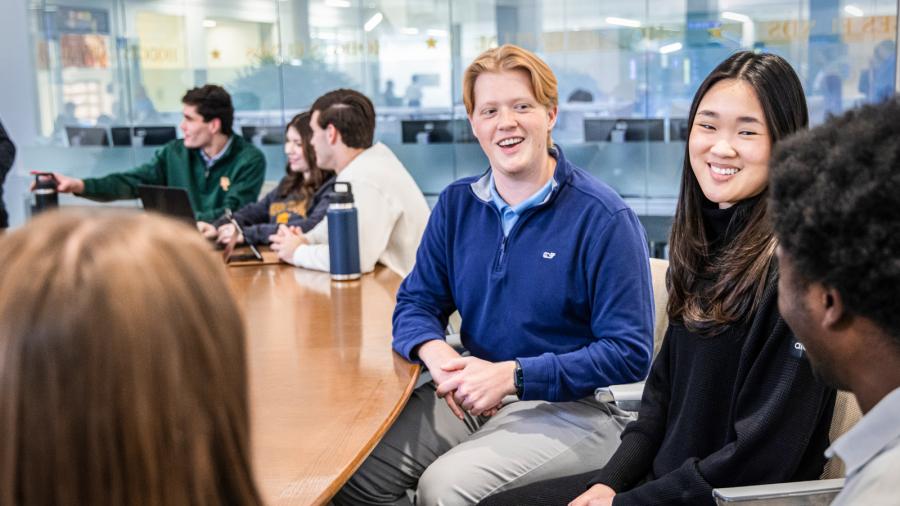
“We’ve helped students understand we’re preparing them not just for this entry-level role, but we’re preparing them to experience getting to the top of the organization,” she said.
Lane Wakefield, M.S.Ed. ’11, Ph.D., clinical associate professor, is another Hankamer faculty member charged with guiding students toward successful careers in business leadership. As the director of the Center for Sales Strategy in Sports and Entertainment (S3E), he and his colleagues help prepare students for a specialized world — the business of sports.
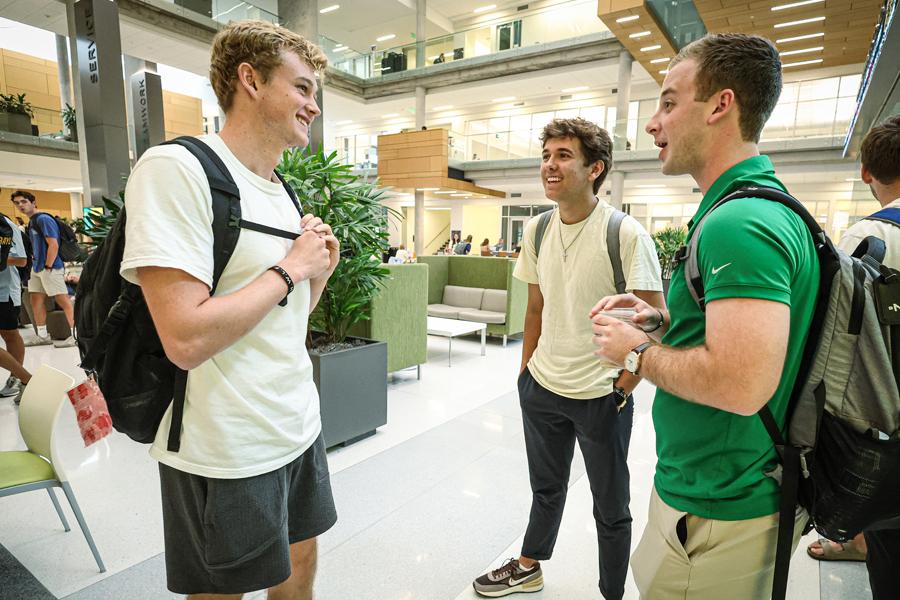
Taken as part of the marketing major for a B.B.A., S3E courses prepare students to pursue sales or analytics roles in sports marketing. In addition, S3E students gain experience through summer internships between their junior and senior years with an organization affiliated with the S3E program or others in the industry.
Wakefield noted that Baylor’s S3E program, which produced its first graduating class in 2006, currently places more than 95% of its students in full-time positions before graduation due to the program’s close partnerships with professional sports teams and leagues and corporations.
Grounded in Christian Values
The Center for Christian Leadership and Ethics (CCLE) stands prominently among the organizations specifically charged with fostering a faith-informed perspective on leadership in Baylor business students.
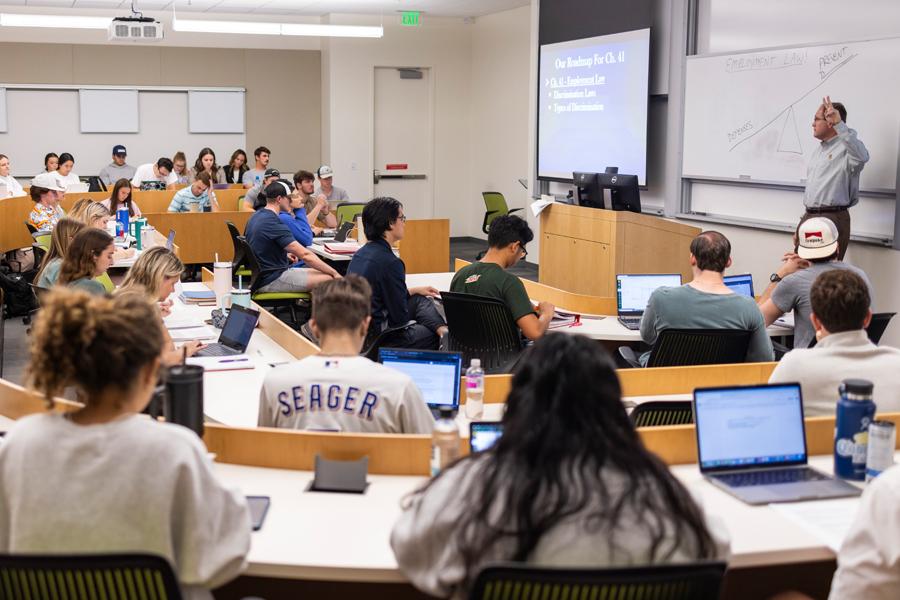
Led by Matt Quade, Ph.D., associate dean for values-based leadership and the Kimberly and Aaron P. Graft Professor in Christian Leadership in Business, the CCLE has flourished in recent years, enhancing existing programs while establishing new opportunities for students, alumni, faculty and staff. Quade explained that the Center has two primary goals. The first is to provide programs that help leaders exemplify and communicate the importance of ethical behavior and service in addition to maximizing profit. The second is to offer programming that helps students and other stakeholders identify and live out their vocational calling.

“These programs allow people to learn, engage and encourage as they connect with each other in a community rooted in Christian values,” Quade said, identifying Christian Leadership in Business, Baylor Business: On Mission and the Armes Family Christian Leadership in Business Summit as being among the Center’s standout programs.
In addition, the CCLE annually hosts the National MBA Case Competition in Ethical Leadership, in which teams from universities across the nation compete for monetary prizes through a 20-minute presentation and a 10-minute Q&A session on their assigned case. While the awards are nice ($4,000 for first place), Quade noted that what matters most is the experience of working through complex leadership issues.
“These students will face many ethical dilemmas throughout their careers,” he said. “Being able to face such complex issues with resolve and integrity is difficult, but it does become easier with practice.”
Hannah Stolze, Ph.D., is another Hankamer faculty member with a passion for helping Baylor business students conceptualize success as a means of reflecting the character of Christ. As the William E. Crenshaw Endowed Chair in Supply Chain Management, as well as a veteran of the U.S. Army and international business, she focuses her teaching and scholarship on integrating Christian values into transformative supply chain management.

“When you read the Pentateuch, the first five books of the Bible, they are inventory books,” Stolze said in describing how business practices can be taught from a faith-informed perspective. She also pointed out that the story told in Chapter 41 of Genesis about Joseph’s interpretation of Pharaoh’s dreams, which leads to a massive system for stockpiling produce to avert famine, is fundamentally about supply chains.
“From the very beginning of the biblical story, we have this picture of God caring about how we get product to people because we need food, we need clothing, we need shelter,” she said. “I love how much scripture can guide us in terms of how we think about supply chain strategy today, especially in terms of opening students’ eyes to the potential witness that they can have if they pause and think about the choices and the opportunities that they have ahead of them in terms of global well-being and human flourishing.”
Building Leaders
Baylor business students naturally benefit from the expertise and experience of faculty and staff members in the Hankamer School of Business, but there also is much to be gained through interacting with their peers, especially those who have already traveled down the same academic path for a few years.
The Billington Peer Leader Program provides just such a resource for today’s Baylor business students. Endowed by Jon and Dena, B.S.Ed. ’88, Billington in 2023, the program is a required component for all first-year, pre-business students and pairs them with upperclassmen mentors. Each year, about 900 participants are assigned to some 80 mentors, who receive a stipend in return for their work. In addition to cultivating success in the student academic experience and fostering community within the School, the Billington Peer Leader Program develops leadership skills in the mentors.
“The program truly helps the first-year students navigate the questions they might think are annoying or weird,” said Madeline Prescott, B.B.A. ’26, who participated in the program as a first-year student and then served as a mentor. “It’s important for first-year students to have someone to look up to, especially since we were very recently in their shoes.”
Laura Lalani, B.A. ’06, associate director for student success initiatives in the Hankamer School of Business, who oversees the Billington Peer Leader Program, said that while the program’s benefit to pre-business students is its most obviously significant aspect, the experience gained by mentors can be equally transformational.

“We do an exit interview with mentors at the end of the year, and it’s really fascinating to hear how the peer leaders themselves grow so much throughout the semester. What is surprising to them is what they’re personally learning,” Lalani said, noting that the “soft skills” of leadership that mentors develop are something they will be able to utilize in the workplace.
Lalani believes the Billington Peer Leader Program, like similar programs throughout the Hankamer School of Business, demonstrates the University’s focus on leadership development and student success. “It’s one thing to say that you want to build leaders, and it’s another thing to put that into action,” she said.