

Bugs Delivering Drugs
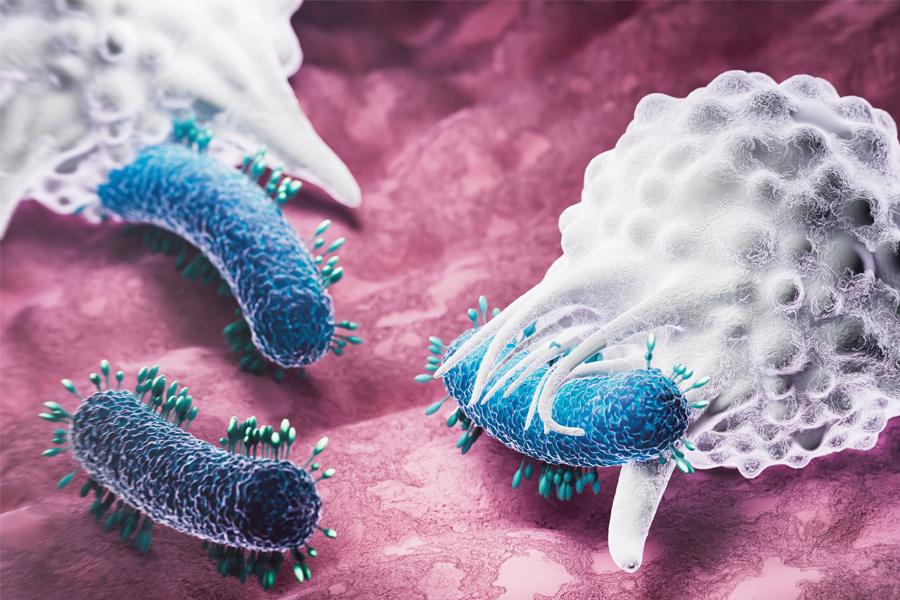
A new approach to cancer treatment
Among cancer types, colorectal cancers stand out, accounting for the second-most cancer deaths in 2025 — a statistic highlighting the need for new approaches to therapy and treatment.
For Michael VanNieuwenhze, Ph.D., and his Baylor students, a new approach began with a simple question: “What if we could hook saporin on the surface of a bug and let the bug get delivered into the cell as it normally would? We could take advantage of chemistry inside the cell to kill the cancer cell.”
VanNieuwenhze, University distinguished professor and chair of biology, recently shared this novel approach in the prestigious Cell Chemical Biology. There, he and Baylor doctoral students demonstrated how a bacterium associated with food-borne illness — listeria — could be a tool to stop cancer.
Listeria monocytogenes can penetrate human cells, making it a useful tool. Researchers attach saporin, a known cancer-killing toxin, to the surface of the listeria bug to deliver cancer drugs more effectively. By chemically attaching saporin to the bacteria, researchers multiplied its ability to fight cancer. As a cancer-killing toxin, saporin is only toxic once it is inside of a cell, and listeria enables it to reach that environment — a bug delivering a drug in a new way.
With this phase of research completed, VanNieuwenhze hopes to further build on that foundation through genetic strategies that could make the process safer and more scalable, with a goal of eventual therapeutics.