

Advancing Readiness in Extreme Environments
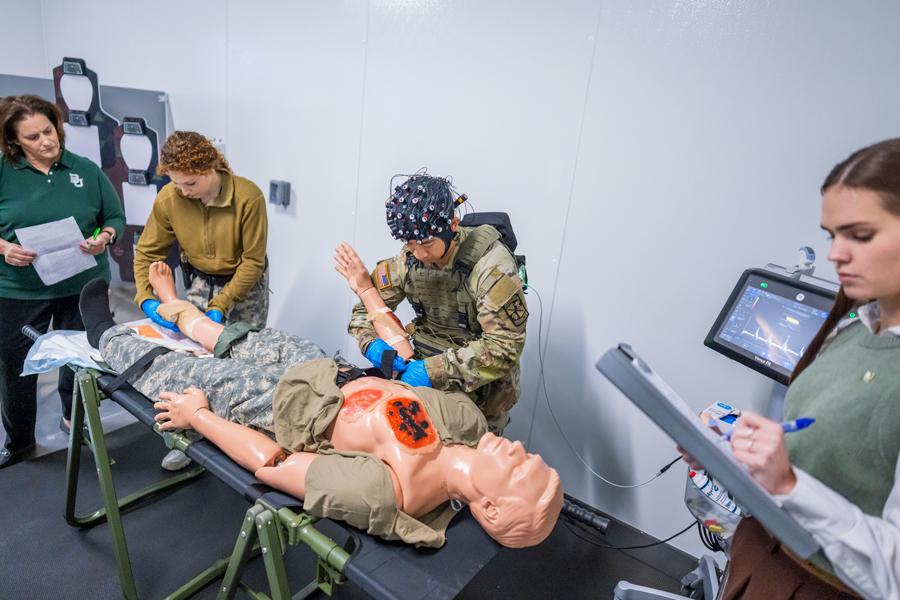
A first-of-its-kind research and development center will equip service members of the U.S. military to handle complex, multi-sensory environments. The Arctic Acclimatization & Sleep Optimization (ARKTOS) Research Center is an advanced, collaborative research and testing facility that will develop products and technologies that assess and mitigate the impact of multi-stressor Arctic environments on sleep, cognition and human performance.
“ARKTOS aims to provide a first-of-its-kind research and development center to test and develop protocols and technologies that will help both military personnel and civilians be more prepared for the rapid acclimatization that might be necessary for Arctic deployment,” said Jason R. Carter, Ph.D., dean of Robbins College of Health and Human Sciences. “The facility also will allow us to harden medical technologies that are not equipped to operate optimally in the Arctic and will even allow us to develop and validate screening protocols for ‘cold-weather phenotyping.’”
Housed in the Baylor Research and Innovation Collaborative (BRIC), ARKTOS provides federal, industry and academic collaborators with access to capabilities, resources and subject-matter experts that would otherwise be cost-prohibitive.
Opening in phases, ARKTOS will equip researchers to test extreme conditions on the human body. The project’s first phase includes the development of an Arctic environmental chamber that can hold temperatures as low as -22 degrees Fahrenheit, while simulating high altitudes by controlling oxygen levels within the equipment. A second phase will add a state-of-the-art motion simulation chamber, which will simulate extreme conditions experienced in real-world operational scenarios encountered by both military and civilian teams.
The chamber will combine environmental simulation technology with an advanced motion platform to create an unparalleled training environment capable of simulating ground transport, air transport (up to 24,000 feet in altitude), snow and mountainsides. This distinct grouping of resources will enable researchers, more efficiently and cost-effectively, to study rapid acclimatization, combat casualty care, tactical decision making, sleep optimization and field-based biomedical device testing.
“It has been reported that eight of every 12 potentially survivable injuries in recent conflicts might have been prevented with proper tactical combat casualty care at the point of injury,” said Cory M. Smith, Ph.D., co-director of ARKTOS and associate professor. “The ARKTOS Research Center aims to reduce that ratio by optimizing medical provider performance in austere environments, creating hyper-realistic simulations mimicking challenging operational environments such as cold and high altitude. The data and research we obtain will be used to optimize patient care and allow medical providers to thrive in these environments.”
The ARKTOS Research Laboratory joins other BRIC laboratories, including the Point-of-Need Innovations Center, Central Texas Cyber Hub, SMART Hub and Baylor Energy & Renewable Systems Laboratory, in advancing diverse technologies and solutions to meet acute and systemic defense needs.