

When Everyone Belongs
Faith, Disability and the Work of Flourishing
The pastor had not begun the sermon when the mother realized she would have to go. Her son, who lives with sensory processing differences, had been softly humming since they sat down. She thought it was too quiet to bother other churchgoers, until people two rows up turned around, searching for the source of the noise. In the parking lot, her son asked if they had done something wrong. Even as she assured him they hadn’t, she didn’t feel so sure herself.
While the Christian faith calls us to pursue accessibility, hospitality and love, this story is not unusual. Nearly half of Texas families raising children with disabilities have left a church because they felt they didn’t belong. Disability is not outside our faith story; it’s at the heart of the gospel. Yet too often it goes unseen, unspoken and unattended — even in church pews.
At Baylor, a simple but profound question arose: Why?
Why is disability so often invisible in spaces that promise belonging? And more importantly, what could it mean if universities, churches, schools and workplaces were equipped not just to accommodate people with disabilities, but to recognize that they are essential to the flourishing of the whole community?
That question has become the heartbeat of the Baylor Center for Disability and Flourishing (BCDF) housed in the School of Education. The story of the Center goes back more than a decade, when a group of Baylor faculty members and students stepped forward with solutions for problems that weren’t being addressed. Children were waiting months for assessment and diagnosis. Parents were desperate for support and guidance. The needs were pressing and opportunities limited. Community clinics were launched to meet immediate needs of children with disabilities and their families in the Waco area.
Growing Foundations of Support and Research
In 2014, these clinics gathered under the shared umbrella of a single center. With a foundation established, the team started to wonder how its scholarship and leadership might reach more people who could benefit from what had been learned. When Erik Carter, Ph.D., joined the Center in 2023 as its new executive director, the mission broadened to serve as a faithful and leading voice in the areas of disability and flourishing.
Carter came to Baylor with more than 20 years of research and leadership focused on the inclusion of people with disabilities. His initial entry into this field was unexpected, but his life course was changed after spending the summer after his college freshman year in the company of other young adults with intellectual and developmental disabilities. The friendships they offered, the faith they shared and the belonging they extended without condition was transformative for him. He sensed a call to a career focused on helping communities become places where such encounters were ordinary instead of exceptional — where the gifts and friendship of people with intellectual and developmental disabilities are readily received.
“More than 1.6 billion people worldwide experience disability,” Carter said. “That’s one in six children, one in four adults and one in three families. Disability is not on the outside of our communities — it’s within our families, our churches, our workplaces and our friendships. When we start to recognize how many people in our midst experience disability, we begin to see the gospel’s invitation differently.”
The Christian Heart for Flourishing
Carter points out that among the nearly 100 universities with disability centers, Baylor is the only faith-based institution to host one.
“We don’t see disability as a problem to be solved,” he said. “We see every person as fearfully and wonderfully made, image-bearers of God. Our calling is to help communities live that out.”
This conviction fuels the BCDF’s work, bringing together rigorous, translational research and a theological vision.
“Our work is grounded in listening,” Carter said. “We ask about the experiences and expectations of people with disabilities. Then we work to break down the barriers keeping their hopes from becoming real. That’s where our research begins.”
Whether in research or practice, every task is driven by a mission rooted in Scripture: The body of Christ flourishes most when all its members are present and valued. Through the course of its work, the Center is encountering more and more churches that want to welcome and serve the disability community, but they are uncertain where to begin. To help address this need, the BCDF — in collaboration with Angela Reed, Ph.D., associate professor of practical theology and director of spiritual formation at Baylor’s George W. Truett Theological Seminary, and Gaynor Yancey, Ph.D., director of the Center for Church and Community Impact and The Lake Family Endowed Chair in Congregational and Community Health at Baylor’s Diana R. Garland School of Social Work — is currently partnering with 16 Texas congregations. The “Bridges to Belonging” project is an ecumenical mix of learning, experimenting and growing together. Over two years, the cohort is listening to the stories of families, reflecting on their current practices and exploring new ways of gathering, preaching and teaching that makes ministry more accessible. The immediate work is on a local level, but the larger goal is learning that can be shared across the country.
“We want the Center to be a hub for impactful work focused on the flourishing of people with disabilities, their families and communities,” Carter explained.
Dozens of faculty and students from across Baylor are already engaged. Some are undertaking research projects focused on identifying pressing needs or effective interventions. Others are providing workshops and training that equip professionals and families with best practices. Still others are providing technical assistance to schools and communities that want to learn to include and serve people with disabilities better. The collective work is what is needed to change the landscape.
Equipping Schools and Churches
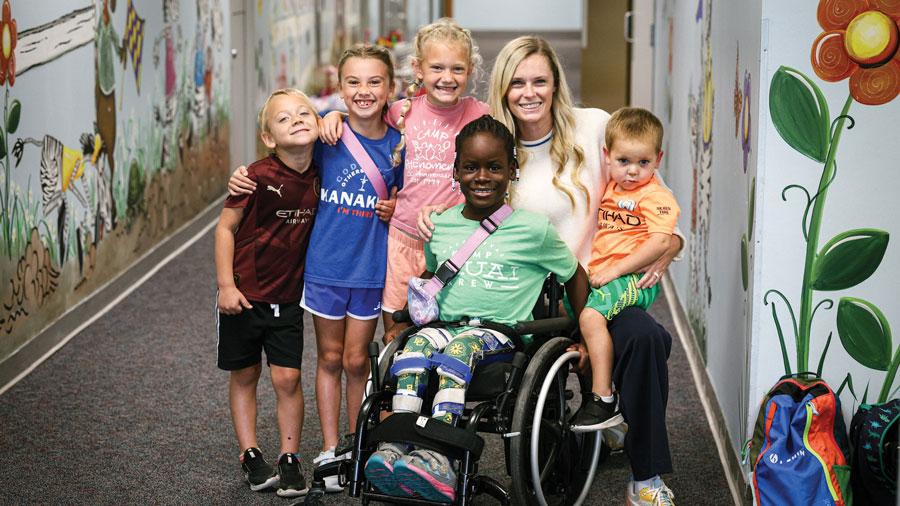
Beyond the walls of the Center, the BCDF sees a unique opportunity with schools to offer support, helping set up models for courage and compassion. While public schools are federally mandated to serve students with disabilities, the country’s Christian schools — counted at more than 19,000 — are not.
“Christian schools can lead the way,” Carter said. “They can show what it means to serve not because the law requires it, but because faith does.”
Similar to churches that want to step up but don’t know how, there are plenty of schools that want to model inclusion but need guidance to create programs, allocate resources and develop a long-term vision. Carter knows that when exemplar schools show how inclusiveness has benefitted all students — opening up opportunities for disabled students, and even more impactfully, teaching resilience and creating a wider world view for others — it can be a powerful incentive for other institutions to follow suit. The crucial step is walking alongside a group of partner schools to create transferable models and programs. That commitment to shared learning continues as students grow into adulthood.
Being rooted at Baylor will always mean the Center has a particular tie to the young adult season of life. For families with children who have disabilities, that time is often one of disorientation as services that have always been provided through school come to an end with high school graduation. In collaboration with Baylor faculty across departments, the BCDF supports clinics that prepare young adults with developmental disabilities for employment and independent living. In the last year, BCDF also began hosting Imago Dei on the Baylor campus. This weekly gathering brings together young adults with and without disabilities for gatherings with worship, teaching and friendship. It’s a glimpse of what Carter calls “the reciprocal blessing of life together,” in which everyone gives, receives and grows.
Kiersten Adams has seen this blessing come to life in her own ministry. Adams is the associate kids minister of Shine at Highland Baptist Church in Waco. Her church joined the “Bridges to Belonging” cohort when it first began and has found the program both affirming of the work Highland has long pursued and inspiring as they consider new directions for future ministry.
“We’ve seen that the heart of the project is to encourage and come alongside us in any way that’s needed,” Adams said. “So much of disability ministry is being intentional and meeting the needs of people wherever they are. What we’ve seen in the Bridges to Belonging project does a great job of highlighting that.”
Adams also spoke to the ecumenical aspect of the group that has come together through the cohort. With churches from all over the community and programs at every stage — including some just beginning to explore disability inclusion — it’s an environment of openness, where everyone is ready to learn from each other.
“Everyone is starting somewhere,” Adams said. “It’s encouraging to be there together.”
Community Rooted in Belonging
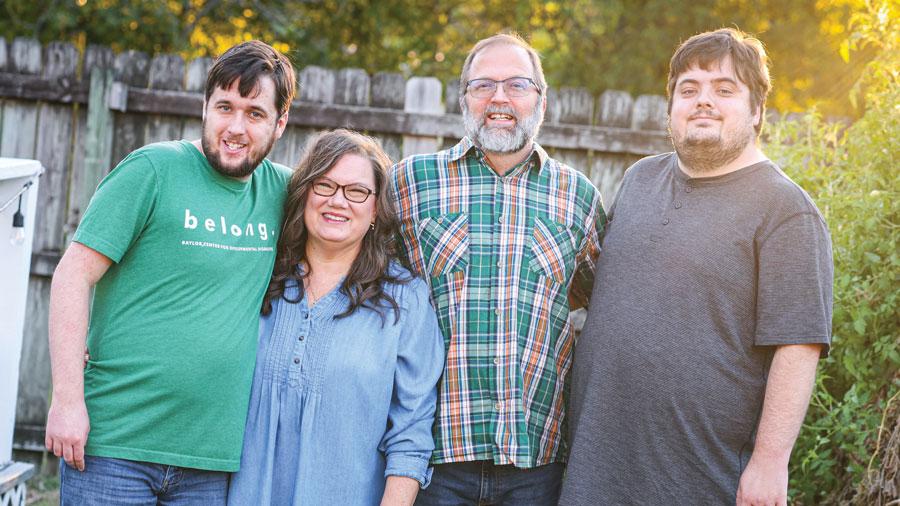
When Gena Baker and her husband Kirk moved their family to Waco three years ago, they hoped for a place where their two adult sons — both on the autism spectrum — could be a part of something larger.
“In Fort Worth we had resources, but finding community was a challenge,” Gena said. “It seemed we were always pushing for awareness, always fighting to make a space for our family to fit in.”
Soon after arriving in Waco, they discovered the work of the BCDF. Gena immediately got her family involved, participating in research and therapy programs designed by Baylor students and faculty, including applied-behavior analysis. Joshua, her younger son, is currently attending a program twice a week where he practices real-world tasks like managing money and running a cash register.
“Watching him do an entire transaction on his own gave me so much hope,” Gena said. “We’ve been in clinical settings, and what the BCDF offers is so much more than therapy. These people believe in my son and want to see him grow — offering opportunities to learn important life skills and develop friendships through social groups, community events and gatherings like Imago Dei.”
The faith component of the community is crucial for the Bakers and is not something they take lightly.
“We know if we teach our sons to have a relationship with God, it will sustain them. Our faith in Jesus has sustained us and our marriage through the years. We would not have made it this far without His faithful love and guidance. That’s why the work Dr. Carter and his colleagues are doing matters,” Baker said.
The Bakers often see others from the BCDF out in the community, which has helped build and extend their network to create an even larger covering for families with disabilities.
“It’s been so encouraging to know we’re not alone,” she said. “There’s a support system out there — people rooting for our kids to know God and flourish in their faith.”
Becoming Whole Together
The work isn’t easy. When speaking of the unknown and uncomfortable spaces that must be stepped into, Baker acknowledged the challenges for all involved.
“It can be intimidating to be faced with situations, not knowing how to help. Even as a parent of children with special needs, I struggle with that — having compassion for the suffering of another but not knowing how to show it or what to do.”
Research, studies and experience have led the Center to believe in community as the space where people can flourish as they learn and grow. The Center knows that simply belonging to a community does not guarantee a person will flourish. Yet it’s a crucial first step, because it’s rare for a person to flourish without it. So every program, gathering and training that creates a tighter-knit community is an opportunity to deepen connections and give people spaces where they can work through the messy challenges of life together.
“When we talk to people with disabilities and their families, they want to be seen and supported, to have connections and community,” Carter said.
He believes that the Center, which started as a handful of small faculty clinics, has the potential to offer just that.
By answering the call in schools, across college campuses and within our congregations, each of us can be part of this transformation.
“When we include and learn from people with disabilities,” Carter said, “we don’t just make their lives better — each of us grows. We become more human, more faithful and more whole.”