

Upstream
Baylor water researchers apply elite research focus to ensure clean water for communities in the future — close to home and around the world.
“What do you hope for when you turn on your faucet every day?” Bryan Brooks, Ph.D., asked. “You hope that clean water comes out. That’s what we all hope for, and it’s something many are able to take for granted — but there are constant challenges to delivering clean water, which challenges us to research and innovate.”
In the Gospel of Matthew, Jesus painted a picture of service on a human level — “When I was thirsty, you gave me something to drink.” At Baylor, researchers focus on this most basic, but life-sustaining exchange — the ability to access clean water when, where and how a person needs it. In so doing, Baylor has aligned internationally recognized research with a missional focus to address the ever-growing challenges to accessing clean water.
“Our water research at Baylor has international dimensions, but it’s also going on in our backyards in ways that matter to our family, friends and neighbors,” said Brooks, distinguished professor of environmental science and public health. “What we’re working on and what matters to rural, urban, poor, affluent — it’s universal, and it’s meaningful to be able to engage with this work with the outstanding people who are our colleagues and students.”

A Collaborative Mindset to Find Solutions
Across campus, faculty in environmental science, biology, statistical science, engineering and more have built a culture of collaboration, applying interdisciplinary insights to tackle multifaceted water quality challenges. Individually and collectively, they have long addressed needs for drinking water, food production, healthy waterways and habitats, fishing and recreation. In recent years, burgeoning demand for water to support growing industries in Baylor’s Texas backyard has uncovered further needs.
Organizations like the National Science Foundation and National Institutes of Health support their research, while city, county and state governments rely on the work of Baylor faculty — both of which bolsters Baylor’s reputation as an elite name in water quality research. But it’s Baylor researchers’ dedication to apply research holistically, addressing needs both pressing and future-focused, that combine mission-centered service with research excellence across dozens of key water quality topics.
Water challenges come from a variety of sources: population growth, movement to urban areas, weather disasters and more. To envision just a few of the ways Baylor research addresses these needs, communities can apply a temporal lens to their water needs — just as they naturally do to serve their citizens.
The Decade Ahead
Across many states and municipalities, water questions come from a place in between the urgent now and the distant future. As communities grow, build new homes or welcome new businesses, it’s important to consider how to ensure continued water access in the coming years.
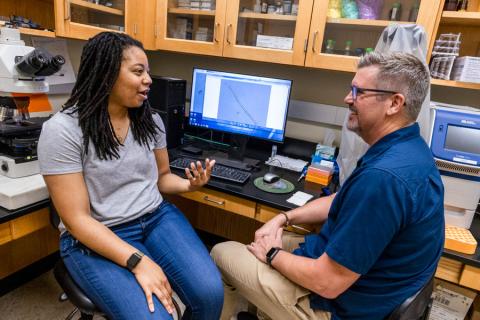
“Every five years, our home state of Texas develops a water plan,” Thad Scott, Ph.D. ’06, professor of biology and director of Baylor’s Center for Reservoir and Aquatic Systems Research (CRASR), said. “The Texas Water Plan’s regional version is underway now, and it will culminate in a new state plan in 2027. This sub-decade to decade scale is incredibly important, because it affects infrastructure — determining how we’ll invest in water needs requires forethought.”
Scott’s research often informs policymakers and leaders with information they need to improve or preserve water resources. A limnologist, Scott and his team study interactions between the environment and humans and forecast future water demands using water data, population data, weather trends and more to project five, 10 and 15 years down the road. In states like Texas, Utah and North Carolina, his insights have helped state or federal agencies make key decisions on wastewater treatment and recycling, which helps communities better manage and save water for drier conditions.
As Scott helps communities plan for future water needs, Katelyn McKindles, Ph.D., assistant professor of biology and a CRASR researcher, helps them navigate the tiniest forms of life within their waterways — microscopic organisms that can have a big impact. Communities are well aware of the impact that cyanobacteria and other microbial life can have on their water quality. Algae blooms are a visible sign of their impact, with water taste and smell most noticeable to consumers.
Often, communities manage their approaches to these life forms without fully understanding the ways they’re interacting with their water systems. McKindles’ expanding list of municipal partners includes Toledo, Ohio, and Wichita Falls, Texas, where leaders are interested in better understanding these impacts to uncover more effective and efficient treatment strategies.
“Cities are mandated to run a variety of tests, many of which are abstracted into positive or negative results without understanding what’s really happening in their water systems,” McKindles said. “They feel pigeonholed with the information they have into specific ways to respond to emerging issues. We’re working to help them understand different metrics to evaluate where their water quality is currently and how we can guide them in the future.”
The data McKindles and her team study can help cities like Toledo address threats both acute and long-term through insights into how microbial communities shift over time. The development of subsequent predictive models can help communities to develop more targeted approaches that both promote water quality and address challenges more efficiently.
Urgent Water Needs
What if water also could be a tool to help communities recognize the threat of disease outbreak before it is widespread? It actually is just that — a tool in health hazard and risk assessment. As Brooks explains, the water tells the story.
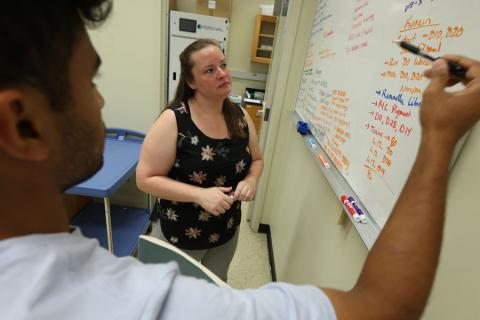
“We’re working with communities on disease surveillance,” he said. “When new diseases move into an area, we can actually measure wastewater treatment systems and find evidence of emerging diseases within the wastewater. This allows us to provide communities with timely information to prioritize resources and protect the health of their citizens as many as two to three weeks before that disease impacts our family, friends or local businesses.”
Wastewater-based epidemiology is one way water can be used for short-term community benefit, but what happens when that water system faces an acute threat, either from accidental contamination or intentional sabotage? Then, minutes count.
Mandy Hering, B.S. ’99, Ph.D., professor of statistical science, is a statistician who did not intend to become focused on water issues. But, through research collaborations, she discovered that her research could help communities navigate time-sensitive challenges.
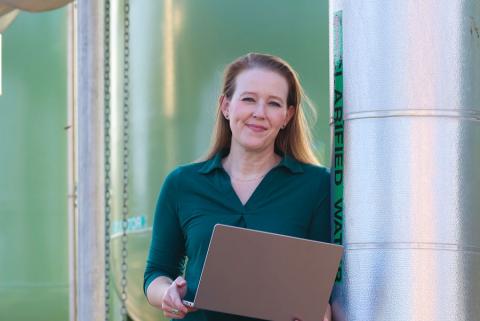
“This was not initially my area of expertise,” Hering said. “But as I was drawn in, what I’ve realized is there hasn’t been as much work done as one would think on using data-driven methods to improve the operation of water and wastewater treatment plants.”
Her introduction to water study was a look at decentralized wastewater treatment plants in Colorado. Decentralized plants have a key strength that also presents a weakness — they operate without a human operator. With an array of potential problems — from oxygen sensor faults to failures in the membrane that separates solids in the water from further travel — a simple equipment error could lead to long shutdowns, with rivers of data to sort through. Hering and her co-researchers have developed statistical methods to identify and diagnose any weakness or faults in the system. They help isolate the troublesome variables to enable systems to become operational more quickly, protecting citizen health and helping communities more effectively and cost-efficiently address these challenges.
Long-Term Planning
What will the world look like 20, 50 or 100 years in the future? Trends toward urbanization are expected to continue, bringing increased stress on municipal water systems. In Baylor’s home state, the Texas Demographic Center projects the state population to nearly double by 2050. Baylor water researchers recognize that the decisions we make now and in the near future will impact what the world looks like for future generations. To make effective decisions now, communities will need to think systemically — and there, Baylor research aids them as well.
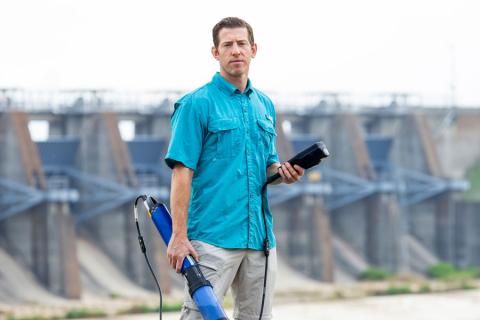
“We want communities to grow. We want them to flourish and be economically diverse and resilient,” says Ryan McManamay, Ph.D., associate professor of environmental science. “The question is, ‘How can they do that in a way that is sustainable, protecting the water systems that we rely on?’”
McManamay is a spatial ecologist whose research spans urban expansion, water infrastructure planning, energy use, the environmental impacts of development and more. His Department of Energy-sponsored work focuses on forecasting urban growth and its environmental impacts, utilizing artificial intelligence and powerful software programs to create tools for future planning — as many as 50 to 100 years in the future. Among his collaborative partners in local governments is the City of Waco, which looks to envision future growth with adequate infrastructure needs.
“Our infrastructures — our energy, buildings, homes, supply chains, transmission networks, water supplies, wastewater and road networks — all support lifestyles that are impactful to the environment — especially water resources,” McManamay said. “We as a society need infrastructure, and we build new infrastructures to meet our needs. That’s really important, but most of the time, our infrastructures are near-sighted. What kind of future do we want, and how will that impact the environmental systems we rely on? That’s a key question we ask. We ask it surrounding water, but also the indirect consequences of changes in the land around the watersheds that influence that water. It’s a broad systemic perspective to help answer these questions.”
McManamay’s wide-ranging research dovetails with long-term research planning by numerous other Baylor colleagues. Hering will soon complete her term on the Department of Energy’s $100 million National Alliance of Water Innovation, whose research is focused on creating a more efficient circular water economy with desalination as a key tool. McKindles expands her models of bacterial behavior into the long-term, while also building a culture collection of bacteria to support broader research and collaboration. Scott has built long-term models of reservoir use in Texas, utilizing data from both drought and abundance, for municipalities to consider while planning new strategies for reservoir management.
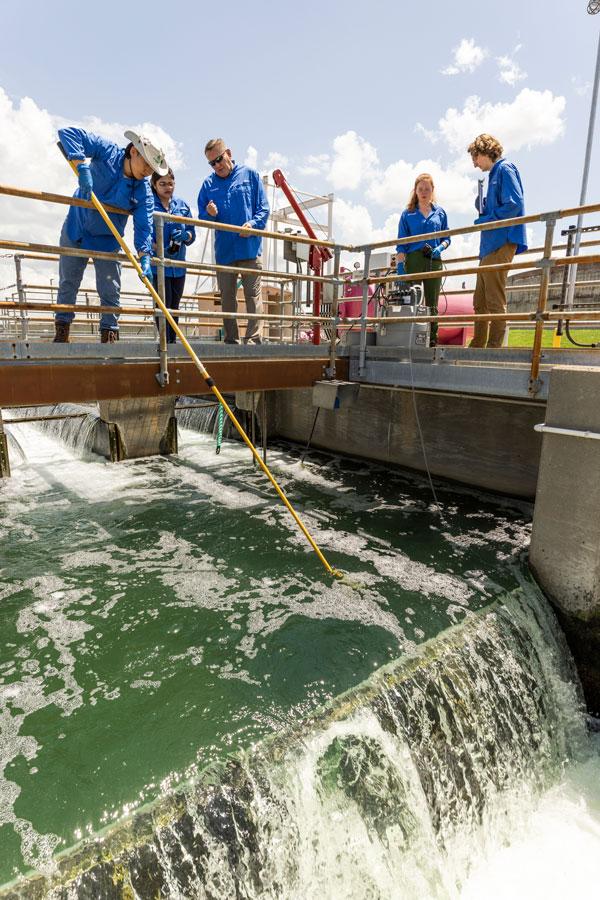
Brooks’ research addresses a current issue of key importance to national leaders — known as “forever chemicals,” per- and polyfluoroalkyl substances (PFAS) pose long-term risks to water quality and public health. Brooks leads research that provides empirical evidence to guide risk-based decision-making. In doing so, he hopes to continue a theme that permeates much of Baylor’s predictive water research: helping municipalities prioritize treatment strategies that are both effective and cost-efficient.
“We don’t want to spend money in places where we’re not getting the most benefit,” Brooks said. “We want to help identify priorities that guide decision making for the benefit of local communities and their citizens.”
A Strategic Homebase for Water Quality Research
Baylor’s home in Waco provides a unique laboratory in which to study the world’s most pressing water challenges. The Waco metropolitan area is growing rapidly and is strategically located in the midst of the burgeoning Texas Triangle, a megaregion roughly stretching around the Dallas-Fort Worth, Houston, Austin and San Antonio metro areas.
“This is such an important geographical location to be in,” Scott said. “Central Texas is at a climatic gradient between east and west. We’re right in the middle of a skyrocketing population corridor along I-35. This provides us and our students so much to study, because what’s happening right here matters.”
The work of Baylor researchers also has taken place with partners around the globe. Brooks has convened stakeholders across the country and around the globe through the Global Horizon Scanning Project and other initiatives to assess regional needs and collaborate with a variety of stakeholders to address these issues on nearly every continent.
No matter where that research takes place, however, it’s undergirded by a foundation of mission and service, infused with interdisciplinary collaboration and bolstered by a reputation for global excellence.
“Clean water is biblical,” Brooks said. “I would suggest that maybe no other science, engineering or health topic aligns better with Baylor’s unique and distinctive mission. What sets Baylor apart in the landscape of research in this area is our focus on water quality and excellent researchers who really want to serve — it’s palpable here. To be a part of that is the most humbling and fulfilling experience we can have.”