

Traditions Run Deep
Meaningful experiences connect generations of Baylor Bears.
Traditions are the enduring connections to the Baylor experience that unite current students, future students, families and Baylor alumni of all ages in fellowship. Whether returning to Waco or finding your own Baylor community wherever you call home, these shared experiences continue to bring together the many and globally dispersed parts of the Baylor Family into one unified body.
Throughout Baylor’s 180 years and counting, traditions have evolved alongside the University. “Coke Hour” became “Dr Pepper Hour.” Baylor faithful showed up to cheer the Bears at Carroll Field, then Waco Municipal, on to Floyd Casey Stadium and today’s McLane Stadium. Even the campus itself moved from Independence to Waco.
“As the oldest continuously operating university in Texas, Baylor enjoys several meaningful traditions that have developed over time. All members of the Baylor Family have memories of their Baylor experience, but it’s our core traditions that carry the heart of what it means to be a part of the Good Old Baylor Line and differentiates Baylor University from any other college or university in the world,” Vice President for Marketing and Communications Jason Cook, A.B.C. ’20, said.
While titles, soda brands, people, stadiums, arenas and even geographic locations change, the spirit of Baylor’s traditions remains anchored in fellowship and belonging for its students, however they find connection.
Columns to Classrooms
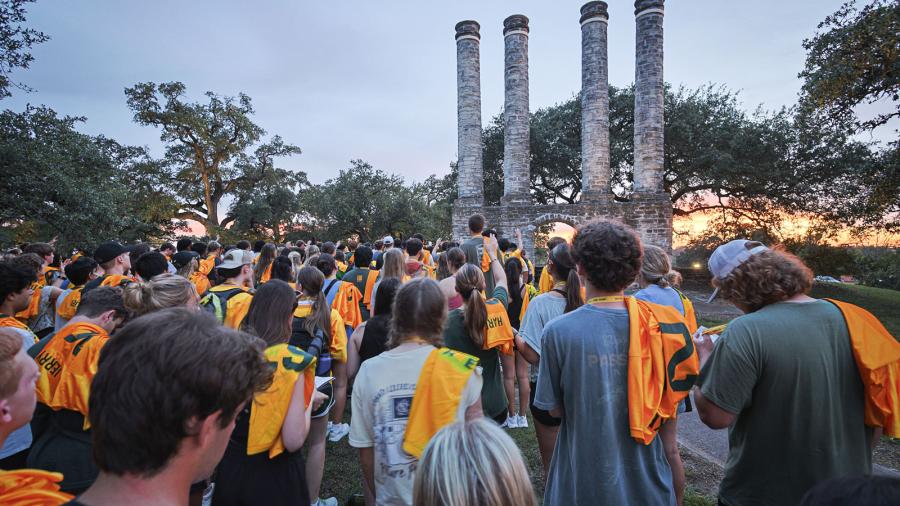
When incoming Bears arrive in Waco throughout the summer prior to their first year at Baylor, the lines of cars entering campus are a sight to behold. Parents attending Orientation both symbolically and plainly see their children transition from their constant guardianship to the independence of college life. And, it’s at Orientation that incoming students first have the opportunity to embrace one of Baylor’s most notable and symbolic traditions — the running of the Baylor Line. According to Daniel Haddad, B.A. ’12, associate director for Orientation, the running of the Baylor Line by first-year students at each home football game symbolizes the Baylor spirit and the metaphoric Baylor Line that “moves forever down the years” and comprises all members of the Baylor Family.
“One of the highlights for new students during Orientation is the opportunity to practice running the Baylor Line at McLane Stadium for the first time. We want students to be invited into Baylor’s cherished traditions at the beginning of their Baylor journey so they understand and experience firsthand that traditions at Baylor are not just fun things we do — traditions tie all of the Baylor Family together.” Haddad said. “It’s important to teach new students the mechanics of traditions, such as running the line, and also to give them a preview of the exciting and rich traditions they will experience when they return to campus to begin their first semester.”
After walking through the two-day Orientation programming, often with their families, incoming Bears head off on their own to Baylor Line Camp where student leaders and staff facilitate deeper introductions to future classmates and the traditions of the University.
From multi-generational students with deep familiarity with Baylor to first generation students who are experiencing the history and culture of the University for the first time, Baylor Line Camp is an important chapter in their Baylor story and their first opportunity to don their gold Line Jersey — the enduring symbol of their connection to the Baylor Line that represents all past, present and future students.
One of the central figures welcoming students during this formative weeklong experience is Alan Lefever, B.A. ’84, the inaugural Russell H. Dilday Endowed Visiting Professor of Baptist Life and Leadership at Baylor’s Truett Seminary, director of the Texas Baptist Historical Collection, author of The History of Baylor Sports and current president of the Baylor Alumni Board of Advocates.
Lefever travels to Independence each summer to share Baylor’s foundational story with these new students, emphasizing how, “Our story – Baylor’s story – is intertwined so much with the earliest years of the Republic of Texas, and Baylor has larger-than-life characters that are part of that story.”
Having the full context of the Baylor story paints a more complete portrait of the transformative experience of a Baylor education. Lefever adds, “Every single important decision I have made since I was 18 years old was affected by the fact that I went to Baylor. It changed my life.”
For Lefever, this profound impact is closely tied to Baylor’s unique sense of family, a concept he traces back to former Baylor President Samuel Palmer Brooks’s original desire to “call the family back together” for the first Baylor Homecoming.
Through Baylor Line Camp, new students not only learn the history and origins of these traditions but begin to live them, understanding that they are now part of a legacy that shapes lives and fosters deep, lasting connections within the Baylor Family.
“I think that’s the most powerful thing about Baylor, and it sets us apart and frankly, it really ties into our Christian faith,” said Toby Barnett, B.A. ’94, Baylor’s associate vice president for engagement and campaign co-director. As a student, Barnett served as a member of Baylor’s Chamber of Commerce, the student organization that puts hands and feet to key Homecoming activities.
“We have this deep, deep heritage of things that we’ve done for over 180 years, and that is absolutely the thing that, when people leave, they take with them, and they want to come back and be a part of what we’re doing now.”
“Faculty and students desire your presence”

The nation’s oldest homecoming celebration, Baylor Homecoming is one of the most foundational Baylor traditions for the Baylor Family. Returning to Waco and “catching the Baylor spirit again” remains a cornerstone experience.
A postcard sent by President Samuel Palmer Brooks for the first Baylor Homecoming in 1909 established a sentiment that remains central to the annual fall gathering to this day: “Faculty and students desire your presence.”
Whether you have past, current or future Bears in the Baylor Family, there is a place for you to gather and be present in contributing to the life of Baylor as it exists today. The current faculty, staff and students not only desire that presence — they understand their experiences are immeasurably enriched by the nearly 130 years of Baylor Family annual reunions.
“Homecoming is foundational to our entire alumni engagement strategy,” Barnett said. “It’s the one time a year when everybody’s on campus. They’re all doing different things, but they’re all coming back to this place we call ‘home.’”
Sharra Hynes, Ph.D., Baylor’s vice president for student life, is in her first year in the role after taking over for long-time administrator, Kevin Jackson, Ph.D., who retired in May 2025.
For Hynes and the student life team, Homecoming is about connecting the present to the former and future.
“It’s establishing Homecoming in the minds of current students as something that is a fall highlight — a way they can see the Baylor Line being actualized in having all of these former students come back and reconnect with campus meaningfully,” Hynes said. “Not just in a pass-through, but through some shared experiences, through some reliving memories. Those core things that are unchanging around Pigskin, and the way we do the parade, and the football game and tailgating. I want Homecoming to be this open arms opportunity, where we as the Baylor Family really embrace everyone who has interest in being here.”
Time-honored traditions like Pigskin Revue, the parade – which Lefever credits as the “largest” in the nation “with over 140 pieces” – Mass Meeting, Singspiration, Extravaganza, class reunions and the football game have joined with newer programs like the Royal & Pure Stroll-Off, Homecoming at the Hurd and the student-focused Dinner with the Livingstones. Together, these individual cords of the weeklong programming braid together to form an enduring celebration of Baylor’s growth and progress.
Baylor Homecoming is the dedicated weekend for all corners of the Baylor Family to gather together — often leading to some priceless portraits of families that have called Baylor home for generations.
“What’s beautiful about Homecoming is you have the current students, but then you have parents and alumni — sometimes it’s three, four generations coming back,” Barnett said. “You can see a picture of a little baby, a current student, parents, grandparents and even great-grandparents. They’re all there enjoying a tradition together that represents a time when they were students. It’s truly a special thing that doesn’t often happen at other universities, but we see it year in, year out here at Baylor.”
Rooted in Faith
As a distinctly Christian university, Baylor holds a unique opportunity among its peers in higher education to lead the way in establishing traditions that celebrate moments of gratitude, hope and salvation through events like All-University Thanksgiving and Christmas on 5th.
“Christmas on 5th for me is particularly poignant, because it not only centers this fun and festive night where you see children and people of all ages enjoying this really beautiful night, but it also centers a distinctive for Baylor,” Hynes said. “That distinctive is our ability and our commitment to celebrate the birth of Christ. Even if you don’t orient around the Christian faith, you have been exposed meaningfully during your time here at Baylor to the Christian faith. The fact that we so freely and beautifully celebrate things like Thanksgiving and Christmas together as a community each year is an important cornerstone experience.”
While not explicitly rooted in a liturgical practice that fosters a communal expression of faith and spiritual identity, Dr Pepper Hour is one of the University’s oldest traditions that focuses on the importance of fellowship within a Christian community.
“There is something special about a sacred rhythm and intentionality for coming together to check in with one another, take a rest from the rigor of the day and casually enjoy an iconic Baylor treat,” Hynes said. “There are countless times where I’ve seen faculty members interact with students at Dr Pepper Hour and engage in meaningful conversations. Those types of interactions exemplify the Baylor experience, and I know students take the lessons and memories from those moments with them when they graduate.”
Natalie Clements, B.S.N. ’98, remembers Dr Pepper Hour with great fondness during her time at Baylor. Clements, whose daughter Ruth is now a current Baylor student, lives in Tennessee and attended a Dr Pepper Hour Tour alumni event in Nashville with her husband, George, B.A. ’94, and their friends, Matt, B.A. ’93, J.D. ’96, and Melodie Adams, B.S.F.C.S. ’99.
“I’ve loved Dr Pepper Hour since I was a Baylor student. It was a time I looked forward to on campus as I had the opportunity outside of the classroom to visit with many of my favorite professors, like Mark Taylor, Ph.D., associate professor of biology,” Clements said. “Dr Pepper Hour provided a casual environment where we could all visit and share our lives. It was really meaningful to be able to experience this tradition in my hometown alongside other Baylor alumni.”
Another embodiment of the Baylor spirit lies in the heart of the Waco campus — the Bill and Eva Williams Bear Habitat.
Home to the University’s beloved live American black bears, Judge Indy and Judge Belle, the Bear Habitat is one of the most visited spots on campus, welcoming guests from around the world. School children from the area stop by to learn about daily care of the bears and management of the facility, while also learning about how important it is to respect bears and their habits in the wild.
With accreditation by the Association of Zoos and Aquariums (AZA) — the first university in the world to receive this designation — along with regulatory oversight and licensing from the U.S. Department of Agriculture, the Bear Habitat is charged with the unique mission of stewardship, education and conservation for the local community and beyond.
Though alumni, parents and friends cannot always make it back to campus for an extended visit, a stop by the Bear Habitat is a fun way to reminisce, catch a glimpse of campus, and often get a peek into playtime with two very active bears.
Flung Afar
Even with consistent draws to campus throughout the calendar year, Baylor also encourages the Baylor Family to take the traditions of the Baylor experience back with them to their home communities.
Whether it’s attending one of the dozens of “Baylor Nights” hosted at MLB, WNBA, NHL and various other professional and minor league ballparks and stadiums around the country throughout the year or simply tuning into the national broadcast of “A Baylor Christmas” on their local news channel or the All-University Sing live stream, Baylor wants to connect with its alumni and friends.
“Our efforts to expand engagement are really about meeting people where they are,” Barnett said. “We’re obviously blessed to have a very loyal alumni base that comes back to Waco for Homecoming, for basketball games, for football games, for all these wonderful events. But we know that not everybody can get back here. So, how can we bring Baylor to them?”
Institutional support of events like Baylor at the Ballpark or the award-winning and innovative Dr Pepper Hour Tour has allowed Baylor’s alumni engagement team to connect directly and meaningfully with Baylor alumni. Baylor is bringing the cherished traditions of the University into the communities they call home.
“I think the future of engagement for Baylor is really about expanding the opportunities for everyone to connect,” said Barnett. “Whether it’s through traditional events, online platforms or new regional initiatives, we want to ensure that every member of the Baylor Family feels valued, connected, and has a meaningful way to engage with their alma mater.”
Each weekend in the fall, dozens of regional Baylor Alumni groups around the country host watch parties for Baylor football games, bringing a small piece of the thrill of gathering at McLane Stadium to their local stomping grounds.
“I hope when they see the Baylor Line run on TV their heart beats faster, like mine does, because it’s thrilling and exciting and energizing,” said Hynes. “When people see those types of things continuing to happen and the student energy behind them, I hope it confirms to them the Baylor experience is alive and well and that students are flourishing. We will continue to prioritize engaging current students in those traditions so that that affinity will grow and be nourished over time.”
No Place Like Home
Whether it’s the lifelong friendships forged at Line Camp or the stampeding crowd of the Baylor Line or simply sharing a frosty Dr Pepper float with friends and loved ones or finding joy in the reverence of holy seasons, the ties of Baylor’s traditions bind together every member of the Baylor Family.
These experiences transcend time and physical distance. They reinforce the fundamental truths of fellowship and belonging that have been at Baylor’s core for nearly two centuries, ensuring that despite evolving landscapes and changing faces, the bonds of community remain deeply felt.
In his Immortal Message, Brooks charged the graduating class of 1931 to, “Build upon the foundations here the great school of which I have dreamed, so that she may touch and mold the lives of future generations and help to fit them for life here and hereafter.”
Baylor alumni carry the intergenerational torch that has been passed from one graduating class to another. But extending throughout the entire Baylor Family – past, present and future learners — is a solid and unbroken line connecting how each individual person uniquely experiences the University’s traditions. No matter what form your support and connection to Baylor may take — according to Brooks’ charge — “have a care for her.”