

New Frontiers in Baylor Space Research
At the beginning of 2025, Baylor’s physics department changed its name to the Department of Physics and Astronomy, a title emblematic of the growing space research portfolio within the department and growing interest in space among students. Long the home of Baylor’s interdisciplinary Center for Astrophysics, Space Physics and Engineering Research (CASPER), the department has built a nationally recognized name for space research — and it’s not the only place on campus where you’ll find researchers bridging the heavens and earth. A few places you’ll find Baylor space researchers include:
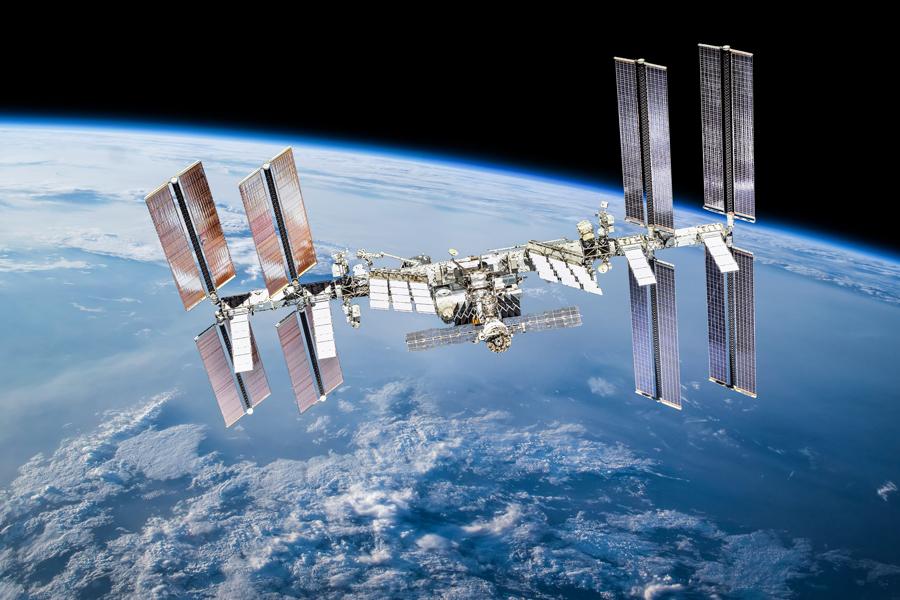
International Space Station
Baylor is one of a select number of institutions that can perform experiments on the International Space Station through a grant from the National Science Foundation (NSF). Baylor’s work on the station is focused on learning more about dusty plasma — tiny bits of rock and ice that interact with plasma and can lead to planetary formation. Lorin Matthews, B.S. ’94, Ph.D. ’98, professor and chair of physics and astronomy, and Truell Hyde, M.S. ’80, Ph.D. ’88, professor of physics and astronomy and CASPER director, lead Baylor’s work on the station.
Nancy Grace Roman Telescope
The Hubble Space Telescope famously unveiled new images of space, and the Nancy Grace Roman Telescope is NASA’s next flagship mission, promising to build dramatically on past capabilities to unveil dynamic images of space. Benjamin Rose, Ph.D., associate professor of physics, is a project leader on a team preparing for the telescope’s future use. His team prepares the data pipeline, standardizing the way that researchers can receive telescope data. He recently led a team that developed a new simulation previewing expected discoveries from the telescope, which is set to launch next year.
Lunar Mission Preparation
As NASA considers future lunar missions, leaders have assembled teams charged with shaping the goals and design of these endeavors. Peter James, Ph.D., associate professor of geosciences, was selected this summer to serve on a NASA Science Definition Team to help determine priorities for robotic exploration to the far side of the moon. James, a NASA Early Career Award winner, has previously studied the far side of the moon in his work, where he discovered an undetected mass beneath an enormous crater in 2019.
Wildfires and Space
Yang Li, Ph.D., assistant professor of environmental science, became the first Baylor environmental science faculty member to earn a NASA Early Career Award for an innovative project using space-based sensing data to better understand the impact of wildfire smoke and pollution.
Early Star Formation
Barbara Castanheira, Ph.D., assistant professor of physics and astronomy, is currently working on a long-term NSF grant studying the evolution of white dwarf stars to learn what can be gleaned from the early stages of stellar evolution. These stars feature an imprint of all phases of their development, like rings on a tree, providing unique insights to scientists.
In-Space Manufacturing
Baylor engineering professors Trevor Fleck, Ph.D., Paul Allison, Ph.D., and Brian Jordon, Ph.D., earned an NSF grant to develop sustainable in-space manufacturing — utilizing
space debris as recyclable material that could allow for the repair of materials away from the Earth’s surface and support human habitation in space.
From physics and astronomy to engineering, environmental science and geosciences, Baylor professors are building a bridge to the farthest reaches of the universe.
“This is the type of work,” said Matthews, “that paves the way for future generations to have an understanding of our world and the complexities of human life.”