

National Honors, Student Focus
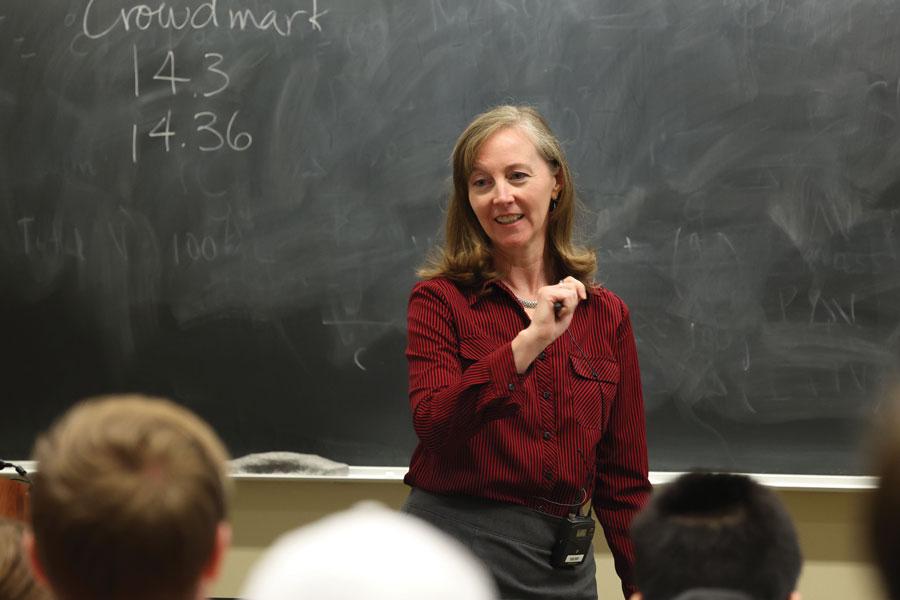
Lorin Swint Matthews, B.S. ’94, Ph.D. ’98, is a national leader in astrophysics for her work studying dusty plasmas — tiny bits of rock and ice that can lead to planet formation. In 2023, she became the first Baylor faculty member ever named as a Fellow of the American Physical Society, a high honor reserved for the most impactful physicists. Even as she maintains an elite research portfolio — including work with the International Space Station — she has maintained a focus on students, earning the distinction of Baylor’s Undergraduate Research Mentor of the Year in 2020.
Baylor Magazine asked Matthews to share some insight into the “why” behind her research.
What motivated you to pursue a career in physics?
Baylor professors encouraged me to do so. I did not feel like I was good at physics in high school, so when I came to Baylor, I followed the footsteps of my two older sisters and majored in chemistry. The summer after my freshman year, I took physics as a prerequisite for physical chemistry. Both of my instructors, Greg Benesh, M.S. ’92, M.D., and Truell Hyde, M.S. ’80, Ph.D. ’88, told me that I was really good at it and should consider switching majors. They were persistent, and I ended up switching my major to physics with a minor in chemistry after my sophomore year.
How did you come to focus on dusty plasmas, specifically?
I got involved in dusty plasma research because I was interested in space. A large part of my research involves studying the earliest stages of planet formation. After a star is formed, the leftover material (gas and dust) forms a disk orbiting the newborn star. It is a bit of a puzzle to figure out how the dust can be collected together into planets.
We’ve realized that if we can really understand how a single spherical dust grain interacts with the plasma, we can use it as a tool to investigate phenomena ranging from turbulent gas flow to how dust builds up on equipment on the surface of the moon. I write computer models to simulate the motion of charged dust, but my favorite part of that is animating the simulations to watch movies of the weird behavior that is taking place. Being able to understand what is going on because your simulation brings to light something that you can’t see in a real experiment is really cool.
You’ve been recognized as a top scientist in your field. What are your hopes for your impact on your discipline?
Over the course of my research career, my students and I have developed a suite of tools that we can use to help others answer their own questions. It brings me a lot of joy when we can put the pieces together to branch out in a new direction.