

Engineering With Impact
Baylor alumni living out their calling through their work in engineering
Whether we realize it or not, the field of engineering touches nearly every aspect of our lives, shaping the tools we rely on, the systems we navigate and the world we encounter. From the invisible networks that carry our voices across continents to the bridges that hold steady beneath our feet, engineering is the quiet force that transforms bold ideas into reality. Behind every innovation are people — curious, persistent and driven to change the world — who spend their days wrestling with constraints and coaxing solutions from complexity. And Baylor engineers take their drive and critical thinking even further by focusing on the why behind the work and exploring the world through a Christian perspective to take on some of the most pressing challenges. Through their professional roles and using their formation and education received at Baylor, these alumni are pushing the boundaries of what is possible or expected in their fields.
Baylor alumni follow their callings into engineering fields where they put their Baylor experience into action – solving real-world problems that make life better and safer for others.
Part of the Solution
Catherine Davis, B.S. ’21, studied mechanical engineering at Baylor, a specialty she selected during the course of her degree because she saw the possibilities the field would open to tackling all manner of problems across different industries.

“Engineering is really a problem-solving discipline, and I think every industry or application that you look at is a different type of problem,” she said.
Davis is in the aerospace industry, in which rapidly advancing technology is opening the door to more approaches in problem solving.
“How can we be faster? How can we be more efficient? How can we produce cleaner energy? How can we look at alternative sources? There are endless interesting problems that are waiting to be solved.”
Davis is a lead control systems engineer at GE Aerospace, where she works on control logic and systems for jet engines that power military aircraft. Two of the main products her team works on are the F414 engine, which powers the F-18 Super Hornet for the U.S. Navy, and the F404 engine, which powers the T-7A Red Hawk for the U.S. Air Force.
“I knew when I was looking for a full-time job that I wanted to do work that was meaningful to me. I wanted it to feel like it mattered. And so I love working in the defense industry,” Davis said. “My brother was in the Coast Guard, and I have a lot of servicemen in the family. And thinking that if the engines I work on are what’s bringing them home safely at the end of the day, then I want all of my work to be the best quality that it can be.”
Davis credits Baylor for developing this sense of purpose imbued in her engineering work. She reflected that an undergraduate degree is a lot about learning how to think and learning the fundamentals of engineering, but that Baylor offers so much more.
“I think what really makes Baylor Engineering and Computer Science (ECS) stand out is how invested the professors are in the students and the personal relationships that you develop in every class.”
Her undergraduate experience was one that focused on shaping the whole person. Davis described ECS faculty as integral to connecting students with professional and educational opportunities beyond the classroom, investing in critical thinking skills that extended beyond the problem to be solved, and encouraging students to enjoy the many experiences Baylor had to offer. According to Davis, an engineering ethics course was distinctive to the foundational education that makes an engineering degree at Baylor stand out, helping students form a Christian ethics perspective in industry.
“That’s a class I go back to and think about all the time,” she said. “There were so many experiences that were beyond just the math and science of engineering that shaped not just the engineer, but the person that I am today.”
Davis knew from a young age that she wanted to be an engineer because she always wanted to be part of a solution to a problem.
“Engineering has equipped me to see problems that matter and do something about them or work on making them better.”
A Game-Changing Career
After an illustrious career as a forensic engineer culminating in his election to the National Academy of Engineering, one of the highest professional honors in the field of engineering, Jim Wiethorn, B.A. ’73, Ph.D., is still changing industry standards to make construction sites safer.
“It’s amazing that after going to school, the education, working in the field, and then I retire and I’m having more fun now using what I did over those 30, 40 years to help people.”
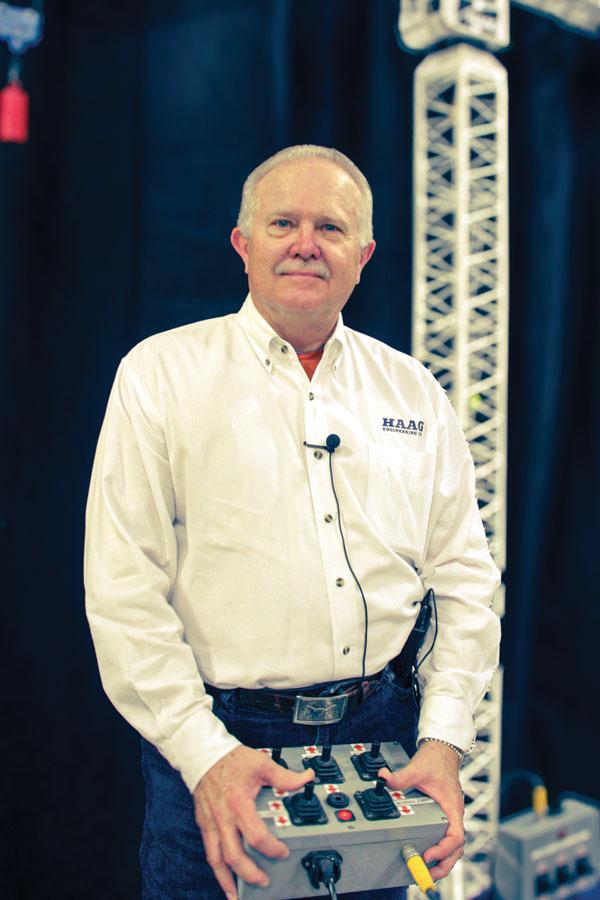
Wiethorn’s path in engineering began long before his undergraduate degree in math and physics with a pre-engineering concentration. Both his dad and grandfather were contractors, and his dad started the company Wiethorn Construction.
“I grew up in construction, and at 5, 6 years-old, I was out on a job with a hammer in my hand — that’s the way it was back then — and learning everything there is to know about how to put things together,” Wiethorn said.
Upon graduating from Baylor, he went on to the University of Texas to complete a bachelor’s and master’s in architectural engineering and a Doctor of Philosophy in construction engineering and project management.
Wiethorn is the founder and chairman of International Crane & Construction Safety Solutions, which specializes in cranes and rigging accidents, as well as investments into crane safety research. His experience includes evaluating and assessing damage and failure of all construction types, particularly crane accidents and operations. He retired from the construction industry in 1987 and then became a forensic engineer providing expert consultation services related to crane, rigging and construction accidents. His long-time experience on construction sites from an early age is a large reason Wiethorn gravitated to data on crane accidents on worksites.
“You often wonder why you do things during your career, and then it comes back, and, hey, that was a pretty good idea. I started collecting information on crane accidents in 1983. Before I knew it, I had collected information on 500 to 600 accidents and decided to start putting a database together.”
The largest database on crane accidents before Wiethorn start compiling data was by the University of Tennessee and contained 100 accidents — Wiethorn has gathered information on more than 1,400 crane accidents, and so far he has inputted 900 of these in a database. Wiethorn has implemented and paid for studies on the database he complied, and the results have international significance.
“I’m just taking bits and pieces, things that I’ve seen in the field, and making it better,” Wiethorn said. “And I say better, safer, because a lot of these things that occur aren’t minor injuries. If I can just send one person home at night because of this, I’ve been a success.”
Wiethorn’s advancement of worksite safety in his retirement goes beyond the experience and expertise on crane operation. He supports the education of future professionals, even advancing the innovations of students that he sees the potential in to change industry standards.
Wiethorn joined the board for Baylor’s School of Engineering and Computer Science in 2008. He supports multiple endowments at Baylor and the University of Texas, because “I want to give kids the opportunity to better themselves, and if you learn something, nine times out of 10, it’s going to make you better. That’s just always been my position, and also my father’s.”
Wiethorn noted that research has been a priority for the school since he began service on the board. For example, board members participate in judging graduate student projects. One project using ultrasound caught his eye, and he has encouraged the student to develop an application of the technology to look through grease to examine wire rope and find defects in the strands in the individual wires, a safety measure that currently is undertaken manually and imperfectly.
“Engineering, and particularly forensics, is the love of my life, I enjoy it so much,” Wiethorn said. “There’s a little bit of Sherlock Holmes in all of us, and that’s what got me into forensics, and same thing with this wire rope and database of accidents. Anything that we can dig into and make a little better makes the field results a success.”
For the Greater Good
Growing up in a household where her mom was in the medical field and dad was in engineering, Sarah Michael, B.S. ’24, had an early interest in both. Michael initially thought she would pursue medicine, until she discovered the two interests could be joined in biomedical engineering. One of her first projects for her engineering degree revealed Michael’s desire to put innovation into practice.
“It was so simple, but that was the first thing I had put my hands on and came up with out of nothing,” Michael said. “That was honestly what made me really enjoy engineering was figuring out how to use everyday things and make them into something they weren’t necessarily intended for.”

Her concentration in biomedical engineering allowed her to embrace the practical innovation she loved about engineering and combine it with a medical background.
Michael uses this same principle of innovation to repurpose things for new functions in her professional role as a technical project manager at Alamo Biologics, a tissue banking company, where she works with human tissue, bones and organs used for transplant and regenerative purposes.
“We make allografts tissue, which is tissue or bones from someone else, getting repurposed for a new thing in your body. So, you can take part of someone's femur and put that in someone else’s spine,” Michael described, even connecting it with what made her first fall in love with engineering at Baylor. “I get to take something and repurpose it for a greater good or different idea.”
Michael started at Alamo Biologics after graduating from Baylor. Not long after, she was promoted to project manager to reflect the expertise that she brought to the table.
“I am so thankful that I got a degree at Baylor,” she said.
Reflecting on how her experience differed from friends studying engineering at other universities, Michael noted that she had more hands-on projects earlier in her degree. One such project was a medical device class and her senior design project, which directly relate to how Michael uses her Baylor degree in her current role.
“We were manipulating the mechanical properties of adipose tissue with vibrational frequency. And it was really cool because I now work with adipose tissue. I got to use my knowledge from that project to advise and consult on how we should move forward with a project in my current job. That helped me get my feet on the ground and establish credibility for myself.”
For Michael, her job offers her much more than the opportunity to combine passions. She is further driven by a greater purpose that she said has even helped her grow in her faith.
“I get to be in a position where we get organ donors, and I love that we call it this, we call them a gift. We get to take that gift and turn it around to someone else and save their life and save a family. It is regenerative medicine. We’re repurposing things for a greater good. So, I think that impact is huge,” Michael said.
“Honestly, this industry is very niche, because once you get into it, you don’t want to leave because it is so fulfilling getting to be part of a greater cause.”
The Baylor Difference
A degree in mechanical engineering from Baylor helped Roy Sherwin, B.S. ’17, stand out and be competitive in his field.
Sherwin noted that the hands-on experiences he gained through Baylor’s Baja Society of Automotive Engineers stood out on his résumé, and professors who invested in the success of their students, like Lesley Wright, Ph.D., and David Jack, Ph.D., were particularly important influences.
“Those were demanding professors, but demanding in a good way, and you could tell they cared so much for their students, and they worked really hard and expected their students to work just as hard.”

Sherwin had more than just exceptional engineering mentors and hands-on experiences — he also was exposed to courses in ethics, church history and Great Texts. He found that reading authors from Plato to Tolkien and taking courses that developed a robust worldview allows him to take technical roles to a higher level.
“I just found myself to be very well-rounded as a person. And I think that does tie in to a significant extent to Baylor requiring us to take multiple courses that are not just math and physics and engineering classes, but we had to learn about church history. We had to take Great Texts,” Sherwin said. “And so what you get out of that is not only very technically competent students but more well-rounded students who have a more developed worldview, who look toward the future and meaningful leadership.”
Baylor’s mission to prepare men and women for worldwide leadership and service resonates deeply with Sherwin, and his undergraduate degree has touched more than his educational and professional trajectories.
“Following graduation, I immediately got active in my community back home before I got my first job. Even after getting my first job, I was active in my community in Detroit when I moved up there. It was evident from my life following Baylor that these principles were integrated in my DNA.”
Out of Baylor, Sherwin received an offer in Detroit from Fiat Chrysler, now Stellantis, as a validation engineer for the powertrain on electric vehicles.
“Baylor’s engineering program is very theory-heavy. I was excited to get a testing role right away, moving from a theory-heavy degree to a very hands-on role.”
Other roles he has held at Stellantis include modeling and simulation testing the durability of a car’s body closures, design systems engineering for electric powertrains, and a design release role for a vehicle’s inverter subsystem. Now, Sherwin is based in Georgia, where he is a process engineering specialist in electric vehicle manufacturing with Hyundai Motor Group.
He sees how innovation in electric and hybrid vehicles can improve individual lives, community structures and be in service to Christian values. Not only can these vehicles be more convenient and efficient, have simpler mechanics and maintenance and allow drivers to spend less on gas, but they also have public health benefits. Lower emissions lead to cleaner air in cities. Sherwin also pointed out that a more sustainable vehicle choice and infrastructure for these vehicles plays an important part in stewarding the world God has created.
Sherwin described his Christian faith as foundational to how he approaches his work and innovation in the industry.
“I’m thankful to Baylor for its mission, because I don’t believe that we live in a material world where we’re just molecules in motion. I believe we live in a created world by a creator God. And if that is true, then that affects everything and particularly the way we work. Having a worldview rather than just a materialistic view is fundamental to my work.”