

Beyond Language
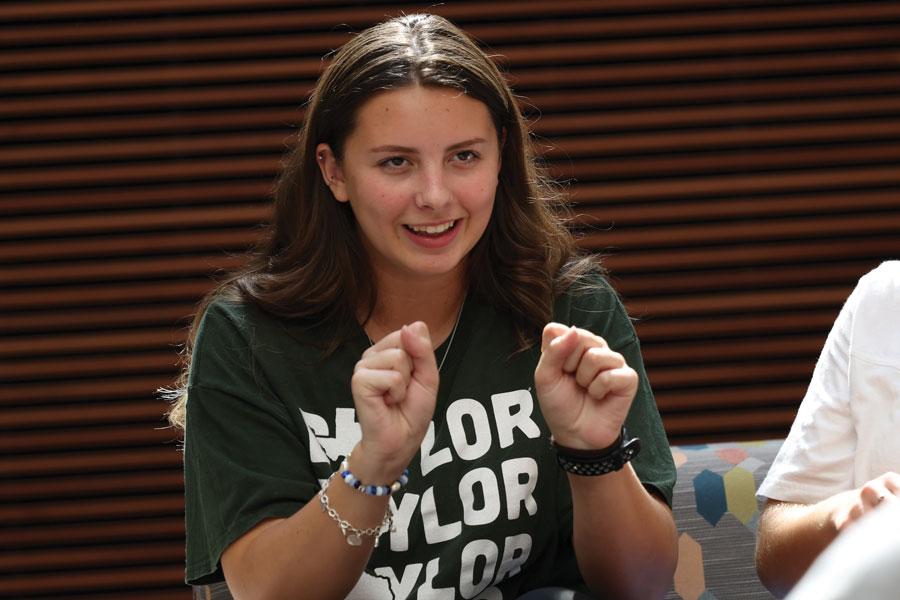
When students enroll in American Sign Language (ASL) courses through the Department of Communication Sciences and Disorders (CSD) in Robbins College of Health and Human Sciences, they may not realize they’re about to learn more than just a new language and culture. The entire experience transforms how they think, communicate and engage with the world while deepening their understanding of the Deaf community and preparing them for a variety of careers.
According to Lewis Lummer, Ed.D., senior lecturer and Baylor’s first known Deaf professor, ASL helps students build advanced critical thinking, complex cognitive skills and stronger overall linguistic abilities.
According to the Harvard Business Review, soft skills like empathy, communication and cultural awareness are not only socially valuable but also increasingly important in the workplace. Research indicates these essential skills are better predictors of long-term career success than technical expertise.
ASL is increasingly popular among students outside the field of CSD. For Miriam Daniel, a junior majoring in medical humanities with minors in ASL and sociology, ASL offers a deeper form of communication that spoken language can’t imitate.
“So many ASL signs convey meanings that simply don’t have words to match,” Daniel said. “When I’m signing, I feel like I can express emotion, tell stories and understand the feelings of my peers in a depth that English does not allow.”
Overall, ASL is tactical, visual-spatial and three-dimensional; learning ASL improves spatial awareness, facial expression control and directional thinking. Lummer believes experience with ASL, rather than a spoken foreign language, can significantly help when seeking employment. He adds that ASL is especially relevant in science and health-related fields, where professionals often work with people who use ASL or whose primary language is not English.
Daniel, who plans to pursue a career in health as a clinical ethicist or in policy, believes ASL is valuable in any field.
“Deaf people are all around us,” Daniel said. “When you can advocate for, connect with and understand the needs of this community, you can find ways to speak up and use this skill in any setting or profession.”