

From platoon leader to linebacker
You'd be hard-pressed to find many college football programs with a 26-year old player on their roster.
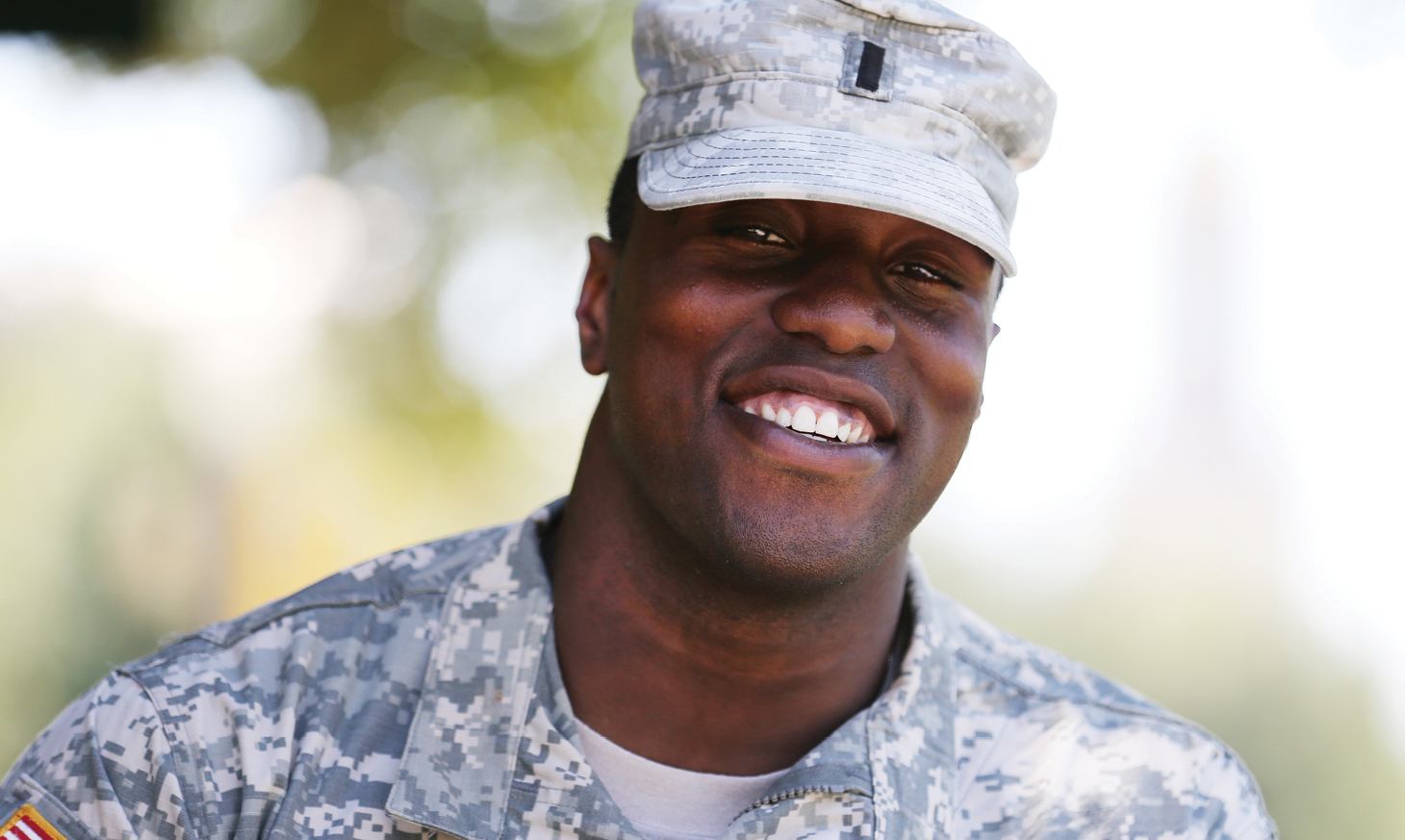
You'd have to dig deeper to find a team with a man who became an Army officer at the age of 22, then returned to college while supporting his wife and two children.
And you definitely won't be able to find another program with a player who, dared by his fellow officers to play another year of college football--five years after last playing a down--went back to play for a certain long-sleeved coach who recruited him eight years prior, fulfilling a dream that seemed to hit a roadblock when a high school injury kept him from playing Division I football.
But you will find that player at Baylor. First Lieutenant Nelson Ehirim, a redshirt junior defensive tackle for the Bears, brings that seemingly unreal combination of leadership, perseverance and dedication to the green and gold, with a perspective no other player in the country can claim.
Nelson's improbable path to Baylor began more than eight years ago as a defensive end for Manor High School near Austin, when he was recruited by coach Art Briles, then at the University of Houston. It didn't take long during their first meeting for Nelson to know he wanted to play college football for Briles.
"He is an expert motivator. He knows how to get through to kids," Nelson says. "That's why I wanted to play for him so badly, because he gave me that confidence. He's a coach who makes you feel like you can do anything."
The dream of playing for Briles seemed to end after an MCL injury his senior year. He went instead to Midwestern State University, where he played for three seasons. He never forgot his desire to play for Briles, but life went on, and did so in a meaningful way. After graduating from Midwestern State, he enrolled in the United States Army and quickly made an impression, becoming an officer at the age of 22.
At an age many young people are only beginning to formulate a path, Nelson was preparing soldiers for battle and honing his leadership skills amidst demanding circumstances. As a platoon sergeant, he managed personnel, led his unit and worked with soldiers through their personal ups and downs. As a federal artillery officer, he taught them to shoot rockets effectively and accurately. But with a growing family to support--he and his wife, Ashley, have a 6-year-old son, Grayson, and 2-year-old daughter, Gianna--Nelson made the decision to pursue a master's degree. Knowing of his plans, his fellow officers upped the ante.
"One day, I was sitting in my office with other platoon leaders, and they started telling me stories about guys who came off active duty to play football," Nelson remembers. "They asked me, 'Will you ever play again?' I said I didn't think I had any eligibility left, and even if I did, it was a long shot. It was really a dare. They dared me to call and find out if I had any eligibility left. That got the ball rolling. I never dreamed it would come to this."
He did have eligibility remaining, and that discovery rekindled the passion to play. The choice to play for Art Briles was obvious.
Eight years after he was recruited, Nelson fulfilled his dream, walking on to the program last spring and stepping on the field in game action in the Homecoming win over Kansas. In practice and away from the field, he embraced the role as mentor and leader to his younger teammates--and laughs along with their good-natured nicknames like "Captain America" and "Pops." In the classroom, he is pursuing a master's degree in sport pedagogy and works with Baylor Veteran and Education and Transition Services (VETS) to help him adjust to life away from a full-time military setting (he continues to serve in the U.S. Army Reserves).
“It's a transition, coming back to civilian life," Nelson says. "But they (VETS) have helped me filter out some of the noise and let my guard down."
VETS helps veterans transition from military to civilian and student life at Baylor through personalized classes, coaching, tutoring and more. The program is in many ways a support system to students like Nelson, who have experienced a side of life that most people their age can't comprehend.
"It's an adjustment that’s ongoing," Nelson said. "There are things I can share with my teammates and classmates, and plenty of things they can teach me. I hope I can bring some awareness to the general student body that we veterans, we're okay, we're normal people, too."