

Learning to give
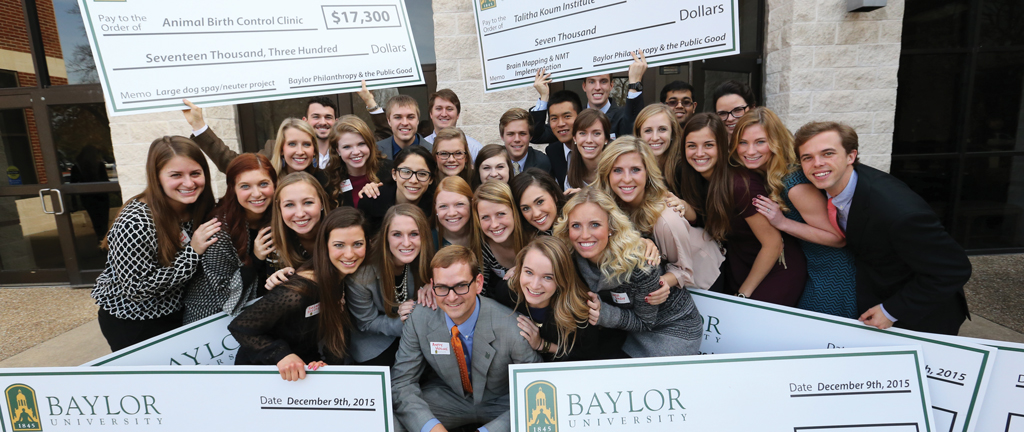
Philanthropy Lab students give away $100,000 to local nonprofits
Thirty students in the University's first Philanthropy Lab course spent the fall semester learning more than the history and philosophy of giving back. They also gained $100,000 worth of real-world experience.
Students in the Philanthropy and the Public Good class were given the tangible responsibility of directing $100,000 in donations to deserving local nonprofit organizations.
After a semester-long evaluation process, the class presented grants to the executive directors and boards of eight nonprofit organizations. The fall 2014 grant recipients are Waco Habitat for Humanity, Family Health Center, Shepherd’s Heart, Communities in Schools for the Heart of Texas, Talitha Koum Institute, Animal Birth Control Clinic, Compassion Ministries and Act Locally Waco.
"What a meaningful experience this has been," said Dr. Andy Hogue, director of Civic Education and Community Service Program, who teaches the philanthropy course. "These students are exceptional. They are sharp minds poised for great things, people of mind and heart, who, true to the Baylor mission, value leadership and service."
Throughout the fall, the students operated as a foundation board of directors, deciding in "board meetings" how and where to give funds; as foundation program officers, cultivating relationships with nonprofits, assessing their needs and effectiveness and in some cases advocating on their behalf to the larger board of directors; and finally as employees of a nonprofit organization, writing grant applications that were considered by the larger board.
Students initially worked with 60 to 70 interested nonprofits to evaluate community needs in key areas such as education leadership and mentoring; health and wellness and basic human needs; culture, arts and the environment; human services and civil rights; and community development. The class divided into teams and researched 10 to 15 organizations each, then engaged in a process that included comparison studies, site visits, grant-writing and debate as they determined how most effectively to distribute real money in addressing local needs.
"Throughout this process, the students have not just been learning the mechanics or the how of grant-making, but they’ve been exploring and reflecting the why and thinking for themselves about generosity and about stewardship," Hogue said. "What does this mean for me at 22 years old with limited income, and what will this mean for me at 25 and 35 and 50 and so on? What does it mean to be generous for a lifetime?"
Jeanne Arthur, a senior communication studies major from Boerne, Texas, took the Philanthropy Lab course to understand why people and organizations are motivated to give. Her team on community development selected Waco Habitat for Humanity Inc. and Act Locally Waco for grants.
"Giving is a transformational discipline that must be developed," Arthur said. "Thoughtful giving is a tool that cultivates character and is life changing for both the giver and the receiver. This class challenged and encouraged all of us to give thoughtfully and purposefully."
Arthur said the semester-long evaluation process for the grants required research, collaboration and honesty among classmates.
"I learned the importance of trusting our classmates when they made recommendations based on their hard work and research. It was also important for the class to be willing to compromise when the allocation process began in order to properly address the needs in our community," she said.
Baylor announced in February 2014 that it would enter into a partnership with the Fort Worth-based Once Upon a Time Foundation, which began The Philanthropy Lab program in 2011. Since its founding, The Philanthropy Lab has given more than $3 million to build philanthropy education at select U.S. universities, including Baylor, Harvard, Northwestern, Stanford, TCU, UCLA, University of Chicago, University of Michigan, University of Pennsylvania, University of Texas, University of Virginia and Yale University. Baylor received $100,000 from the foundation to distribute in fall 2014.
As Hogue praised his students as "leaders in this work of generosity," he also celebrated the collaboration of “eight extraordinary organizations, who have given much to us at Baylor."
"Through the generous work of our community partners, our students have learned about nonprofit work, have witnessed professionalism with a stirring dose of compassion and have been inspired by a vision for a world in which courage, imagination and generosity light the way toward a better future," Hogue said. "This experience, we hope, has been transformative for everyone involved, and we are thrilled that it won’t stop here."
The Philanthropy and the Public Good class has received so much student interest and support from community partners that, with the generous backing of Development and the Provost’s Office, Baylor will offer the class again in the spring. Students taking the class then will have at least $50,000 to give in grants to nonprofit organizations.
"The Philanthropy Lab program fits at Baylor University because Baylor is a place that already understands the significance of recognizing the needs of our local and even global neighbors, and of thinking about how to thoughtfully serve them," said Lauren Wolter, program director of The Philanthropy Lab. "Training students how to examine monetary giving decisions is just an extension of the core values of giving and civic engagement that are already ingrained here in the fibers of the University."